30周年回顾 第六章 王国衰落
Chapter Six
"Fall of the Kingdom"
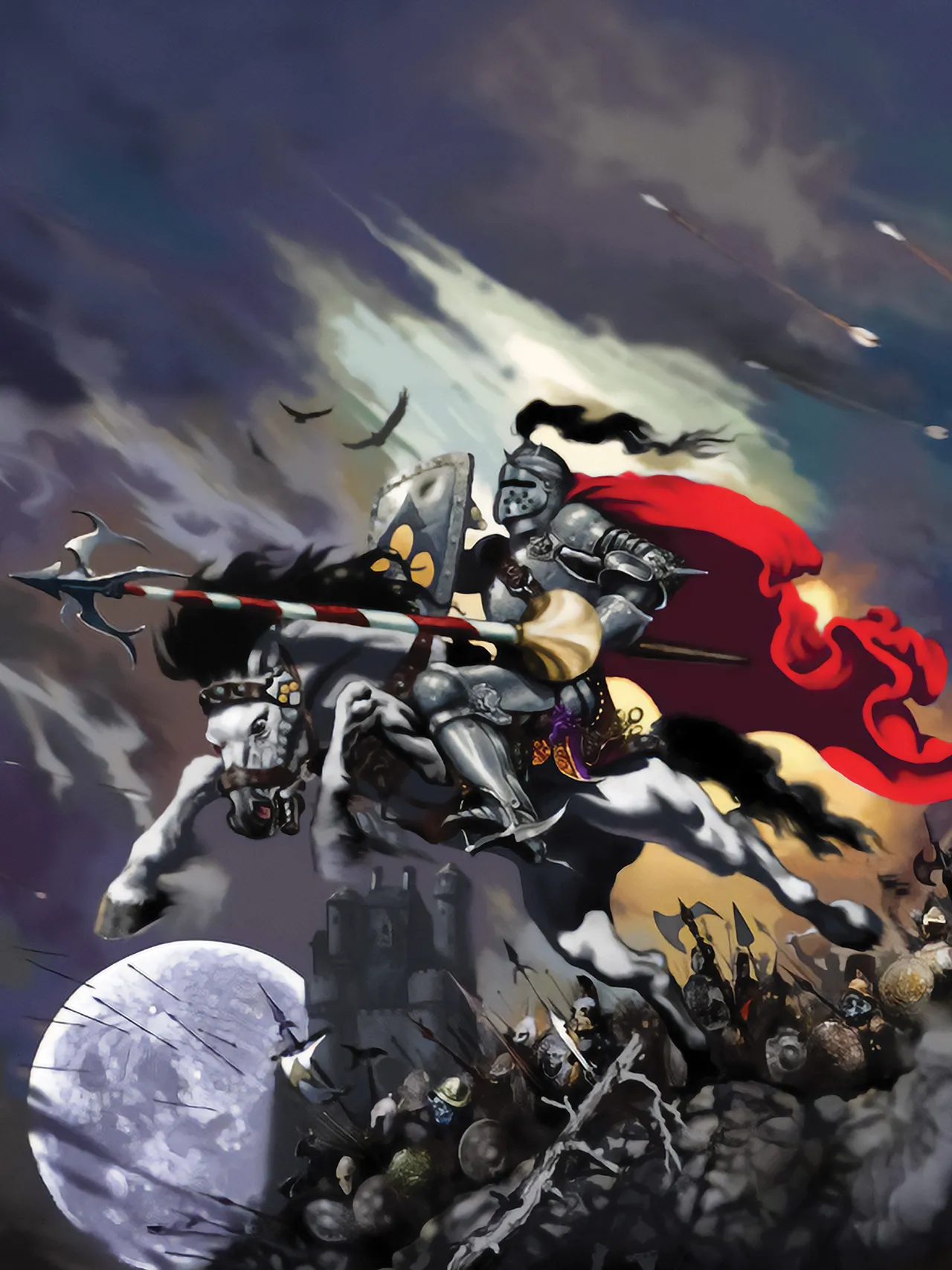
I think after Heroes III was when I really became disenchanted with 3DO," Jon Van Caneghem sighed. He was smiling, but his eyes told a slightly different story. Even after the passage of so many years, it was still uncomfortable for him to discuss this part of the New World Computing saga. “I don't remember how many expansions to Heroes III that they made us do. They were breathing down our necks, and that's when things started to fall apart. They wanted more products, more products, more products-wanted us to move faster. We had to make Might & Magic VI, VII, and VIII all with the same engine, which, you know, got old pretty quick. And we had no time. Just no time. We had to put out one a year with them saying, 'Yeah, we need to move on, we need the next generation of tech.' They wanted us to do like Bethesda was doing. Might & Magic VII was way ahead of Bethesda in terms of open-world RPGs at the time-I think they'd barely even started Daggerfall-but we were stuck churning things out. And they wanted the next Heroes yesterday.”
“到《英雄无敌3》发布之后,我才真正对 3DO 公司感到失望。”乔·万·坎内根叹了口气。他面带微笑,但他的眼神却透露出另一番意味。即便过了这么多年,提及 NWC 公司那段历史中的这一部分,他仍感到有些不适。“我不记得他们让我们做《英雄无敌3》的扩展多少次了。他们紧追不舍,那时一切都开始失控了。他们想要更多的产品、更多的产品、更多的产品,想要我们加快速度。我们不得不用同一个引擎制作《魔法门》6、7 和 8,你知道,这很快就过时了。而且我们没有时间,根本没有时间。他们要求我们每年推出一款游戏,还说‘是的,我们需要前进,我们需要新一代的技术’。他们想让我们像贝塞斯达那样行事。《魔法门7》在开放世界角色扮演游戏方面远远领先于贝塞斯达——我觉得他们的《匕首雨》甚至才刚刚开始完善——但我们却被迫不停地推出游戏。他们就希望《英雄无敌》系列的下一部作品立马能完成。”
More and more, Caneghem disagreed with Trip Hawkins over the relentless pace of development, and was generally unhappy with how New World was being directed by 3DO. “I had this argument with them about franchises. I told them you can keep a good franchise going indefinitely if you leave enough time between versions and you improve what you do in the next version. If you've got a hit and people love it, you've got to take time to make the next one correctly. You can keep doing that every two, three, five years. It'll last indefinitely if you keep up with the times and add new stuff and expand on it. But they weren't giving us time to build a new engine. We didn't have time for new tech. We were struggling just to keep up with new products that were jumping past us engineering-wise, feature-wise, and graphics-wise.”
渐渐地,坎内根与特里普·霍金斯在开发速度过快的问题上产生了分歧,并且对 NWC 公司由 3DO 公司主导的运作方式也感到不满。“我和他们就系列游戏的问题争论过。我告诉他们,如果在不同版本之间留出足够的时间,并且在下一版本中改进内容,那么一个优秀的系列游戏就可以一直延续下去。如果有一个热门游戏并且人们喜欢它,那么就应该花时间把下一版做好。每隔两年、三年或者五年就可以这样做一次。只要我们能跟上时代的步伐、不断添加新内容并对其进行扩展,就能无限期地延续下去。但他们没有给我们时间去开发新的引擎,我们也没有时间采用新技术。我们只是在努力跟上那些在引擎、功能和图形方面都超越我们之产品的步伐。”
After months of creative disagreement, Caneghem at last reached his breaking point. “I was burnt. I didn't like where things were going, and it was hurting our products. When I realized they weren't listening to me, I finally put my hands up and said, 'All right, I'm gonna step back. I'll be consulting and working on stuff, but I'm not going to be involved the way that I have been in the past.' I voluntarily reduced my salary. I almost retired from the game industry. They looked at me like I was crazy."
经过数月的创意分歧,坎内根终于忍无可忍了。“我受够了。我不喜欢事情发展的这种趋势,这正在损害我们的产品。但我意识到他们根本不听我的话,我最终举起双手说道:‘好吧,我得退一步了。我会继续做咨询和研究工作,但不会再像过去那样深度参与其中了。’我主动降低了自己的薪酬。我差点就直接退出游戏行业了,他们看着我,仿佛我疯了似的。”
Caneghem's creative "step back" would have a pronounced impact on everything at New World Computing. Since the company's founding, he'd kept a firm hand in the development of every game the studio had created. With 3DO's strongarm tactics, however, he felt as though he'd already lost the creative control that he needed to make sure future games lived up to the reputations of their predecessors. "I maybe came into the office a couple of days a week. I was very disconnected. I decided to just let my teams do their stuff, and told the lead designers to go at it. I'd test the games and give comments, but I wouldn't be in the trenches every day. I kind of let everyone off the leash."
坎内根的这种“退一步”的想法对 NWC 公司的一切都产生了深远的影响。自公司成立以来,他一直牢牢掌控着工作室所开发每一款游戏的创作方向。然而,由于 3DO 的强硬手段,他感觉自己已经失去了必要的创作控制权,无法确保未来的游戏能够延续前作的声誉。他坦言:“我可能每周只来公司几天,我完全与外界脱节了。于是我就决定让我的团队自由开展工作,让首席设计师们放手去做。我会测试游戏并给出意见,但不会每天都在现场监督。我算是把大家放任自流了。”
While Caneghem felt he was being controlled like a puppet from above, director David Mullich found that his art team objected to the way that he'd run things during the production of Heroes III. "I got called into a meeting that was kind of an ambush. The artists were apparently upset with the artistic control that Phelan and I had taken on Heroes of Might & Magic III. They were asking me, 'Who should have creative direction for the games?' and I could tell they were hoping I would say, 'Me, the director,' so they could pounce and say, 'No, it should be the art director,' but every time they asked that—like four or five times—I kept telling them it was Jon Van Caneghem. He was the person with total creative control. And they would kind of mumble, 'Well, of course he should.' But they kept going at me."
坎内根感觉自己就像被丝线操控的木偶一样,而总监大卫·穆里奇则发现他的美术团队对他在《英雄无敌3》的制作过程中所采取的管理方式表示不满。“我被叫去参加了一个有点出乎意料的会议。那些艺术家显然对我和菲兰在《魔法门之英雄无敌3》中所实施的艺术控制方式感到不满。他们问我:‘游戏的创意方向应该由谁来把控?’我能感觉到他们希望我回答‘是我这个总监’,这样他们就能趁机说“不,应该是艺术总监”,但每次他们这么问(大概有四五次)我总是告诉他们应该是乔·万·坎内根。他是拥有完全创意控制权的人,而他们则会嘟囔着说‘嗯,当然应该是他。’但还是在纠缠不休。”
Mullich admits that the confrontation came as a complete surprise. He'd had no sense beforehand of their collective grievances, but his focus on getting Heroes III out the door had potentially blinded him from seeing some of the deeper troubles brewing at New World Computing. His Heroes lead programmer, John Bolton, was feeling similarly ill-used by New World's general manager, Mark Caldwell. "At some point I guess Mark lost confidence in me, and I think he was telling people that it was my fault that the game didn't ship when he had originally wanted it to." Bolton, along with David Mullich, had informed Caldwell early in the production of Heroes III that the game would take fourteen months—rather than twelve—to finish. "I wasn't having anything to do with that. Then some people below me joined in saying 'This game is not gonna be finished. No way.' And I kept having to tell them, 'Don't worry, don't worry. We'll be okay, everything will be okay.' So, there were problems from below with the amount of work and things that needed to be accomplished, and the pressure from above was also pretty intense."
穆里奇承认这场冲突完全出乎他的意料。此前他并未预见到他们集体存在的种种不满,但他在全力推动《英雄无敌3》的发行工作上投入了过多精力,这可能使他未能察觉到 NWC 公司内部正在酝酿的一些更深层次问题。他的《英雄无敌》首席程序员约翰·博尔顿也同样感觉到了 NWC 公司总经理马克·考德威尔的慢待:“我想在某个时候,马克对我失去了信心,而且我知道他在对别人说,游戏未能按他希望的时间发行是因为我的过错。”博尔顿和大卫·穆里奇在制作《英雄无敌3》的初期就曾告知考德威尔,这款游戏需要 14 个月才能完成,而不是 12 个月。“我再没参与任何与此相关的事情。后来我的一些下属也加入了进来,说‘这款游戏肯定完不成了。根本不可能’,然后我就不得不反复地告诉他们说:‘别担心,别担心。我们会没事的,一切都会好起来的’。所以,从下面来看,需要完成的任务和工作量已经存在一些问题,但上面施加的压力还是非常大。”
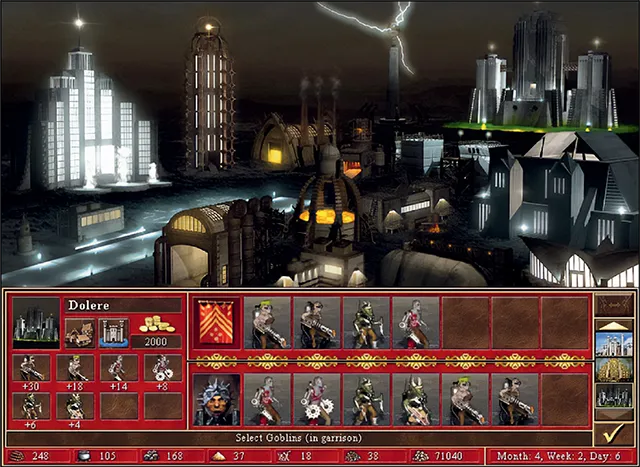
ABOVE: The sci-fi trappings of Forge Town were impossible to miss in this concept created in Maya by lead artist Phelan Sykes.
上图:在艺术总监菲兰·西克斯使用 Maya 软件创作的这一概念图中,铸造族的科幻元素令人难以忽视。
Despite his aggravations, Bolton managed to tough it out long enough to develop innovations that would make the games look better than ever before. "This was just as 3D video cards were coming out. I was exploring how we could adapt the game to 3D or harness the power of 3D video cards. I was experimenting with new ways of rendering so we could have layers of tiles and transparency and things like that so it would look a lot better. Instead of snow having a hard edge, for example, you could have it fade into the other tiles and things like that." His work would produce tremendous results for the next full iteration of Heroes, but he'd be off to work for another division of 3DO in the San Francisco Bay Area before the world got to see it.
尽管内心充满烦恼,但博尔顿还是坚持了下来,最终成功研发出了诸多创新技术,使得游戏的画面效果比以往任何时候都要出色。“当时正是 3D 显卡问世之际。我一直在探索如何将游戏适配为 3D 格式,或者如何利用 3D 显卡的强大功能。我还在尝试新的渲染方式,以便能够实现多层贴图效果、透明度等功能,从而让画面看起来更加精美。比如雪不再有清晰的边缘,而是可以逐渐融入贴图之中,诸如此类。”他的工作成果为《英雄无敌》的下一次完整迭代带来了巨大的提升,但在此之前,他已被调往旧金山湾区的另一家 3DO 部门工作,其成果要到很久之后才被世人所见。
David Mullich recalled that very little time elapsed between the completion of Heroes of Might & Magic III and the start of development for the first official expansion, Armageddon's Blade. "I don't remember any real period where we were resting on our laurels," Mullich said. "We rolled on to it pretty quickly."
大卫·穆里奇回忆道,从《魔法门之英雄无敌3》完成到首部官方资料片《末日之刃》的开发启动,其间的时间间隔非常短。“我不记得我们有过任何真正的安逸时光,”穆里奇说,“我们很快就继续投入到新的工作中去了。”
As a simple expansion, the project should have been a breeze for the team to develop. Apart from the inclusion of an updated map editor, there were no new features in the pipeline for the add-on. From a gameplay perspective, it was intended essentially to be the same as Heroes III, but spiced up with new heroes, troops, maps, and campaigns. "One of the things about doing expansions is you kinda already have a framework to work from," explained Jennifer Ballard. "Once you have a box in which you're working, it's so much easier and so much faster to be creative within that box because you know what the boundaries are. And because you're not trying to change the underlying mechanics or create new ones, you can focus on building out the story and making a bunch of maps that flow together better." What none of the design team could have anticipated, however, was how the proposed inclusion of a new faction—based on deep lore from the Might & Magic RPG—would create a massive fan backlash even before the expansion was shipped to players.
作为一部简单的资料片,该项目对于团队来说本应很容易完成开发。除了新增地图编辑器更新之外,该资料片中并没有新的功能需要筹备。从游戏玩法的角度来看,它本质上与《英雄无敌3》基本相同,只是加入了新的英雄、部队、地图和战役。“做扩展内容的一个特点是,你其实已经有了一个可以依循的框架。”詹妮弗·布劳德解释道,“一旦你有了工作框架,在这个框架内进行创意发挥就会变得容易得多、也快得多,因为你清楚界限在哪里。而且因为你并不准备改变底层机制或创造新的机制,你可以专注于构建故事,并制作一系列更连贯的地图。”。然而,设计团队中没有人能预料到的是,提议加入的一个基于《魔法门》角色扮演中深厚背景故事的新派别,会在资料片交付给玩家之前就引发粉丝们的强烈抵制。
Long before the first Heroes game, the Might & Magic universe freely mixed elements of science fiction and fantasy together. It is absolutely foundational to the shared narrative universe of Enroth in which both the Heroes and Might & Magic games had been set. And yet, the sci-fi underpinnings of the world had never been mentioned in any way in the first three entries of the Heroes franchise. As far as many players knew, there were no robots, spaceships, or other nasty techy surprises to be found lurking beneath its thin veneer of Unicorns, Dragons, and Angels. What Fulton proposed to do, however, was to at last tie Heroes more closely to its Might & Magic roots by exploiting the mythology of the Heavenly Forges.
早在《英雄无敌》第一部诞生之前,《魔法门》宇宙就已将科幻元素与奇幻元素自由地融合在一起。这无疑是恩洛斯宇宙——《魔法门》与《英雄无敌》游戏共同故事框架的基石。不过,在《英雄无敌》系列的前三部作品中,这个宇宙的科幻背景从未被提及过。据许多玩家所知,在独角兽、龙和天使的外表之下,并没有发现任何机器人、宇宙飞船或其他令人不安的高科技元素。但富尔顿提议要做的是,通过利用“天堂铸造”的神话传说,最终让《英雄无敌》与《魔法门》的根基更加紧密地联系在一起。
The lore, as established by Paul Rattner in the then-recently released Might & Magic VII, was centered on the existence of meta-magical machines called Forges. Able to produce new items from thin air using blueprints, or able to scan and perfectly reproduce any object in unlimited quantities, the Forges were loosely modelled on Star Trek's replicator technologies (representing yet another New World nod to the seminal sci-fi series).
正如保罗·拉特纳在那段时间发布的《魔法门7》背景故事中描述的那样,该设定的核心内容是存在着一种被称为“铸造”的超自然机器。这些熔炉能够根据蓝图凭空制造出新物品,或者能够扫描并无限量地完美复制任何物体。这些熔炉的设计灵感部分源自于《星际迷航》中的复制器技术(这也是对这一开创性科幻系列作品的又一次致敬)。
Fulton's plans were to introduce a new town called Forge which employed this decidedly sci-fi tech. The town would be capable of churning out new, technologically enhanced troops that were slightly better than any other faction's troops in the game, but would be more expensive and take longer to produce to offset their tactical advantages.
富尔顿的计划是引入一个名为“铸造族”的新派系,其城镇将采用这种极具科幻色彩的技术,生产出全新的、技术升级后的部队,这些部队在游戏中的战斗力略高于其他任何派系的部队,但会更昂贵,生产时间也会更长,以抵消其在战术上的优势。
In the team's early discussions about the new faction, Mullich and Fulton had very different visions about how it should be visually portrayed. “David dropped the name Jules Verne. I immediately thought of Twenty Thousand Leagues Under the Seas, Journey to the Center of the Earth, War of the Worlds, The Time Machine, etc. What he was proposing sounded like art deco, but I had envisioned the Forge being a horrifying, corrupting, evil faction. To me, it should feel more like something from World War II.”
在团队早期关于新派系的讨论中,穆里奇和富尔顿对于其视觉呈现方式有着截然不同的看法。“大卫提到了儒勒·凡尔纳这个名字。我立刻想到了《海底两万里》、《地心游记》、《地球争霸战》、《时间机器》等等(后两篇非儒勒·凡尔纳作品)。他所提议的风格听起来像是装饰艺术风格,但我在脑海中想象的铸造族则是一个令人恐惧、具有腐蚀性且邪恶的派系。对我来说,它应该更像二战时期的产物。”
After talking things over with lead artist Phelan Sykes, Fulton found that her conception was much more aligned with his than with Mullich's. “Where David pointed to Jules Verne, Phelan pointed to the movie Metropolis,” Fulton said. “Phelan wanted a very gritty, very grungy, very squalid look. We'd call it steampunk today. She sold me on that direction.”
在与首席美术菲兰·西克斯进行深入讨论后,富尔顿发现菲兰的想法与自己的构想更为契合,而非与穆里奇的相符。“大卫指向了儒勒·凡尔纳,而菲兰则指向了电影《大都会》。”富尔顿说道,“菲兰想要一种非常粗粝、非常肮脏、非常破败的风格。我们如今会称之为蒸汽朋克风格。她说服我选择了这个方向。”
Sykes loved the idea of tackling something new for Heroes, not only because it introduced some visual variety into the game, but also because it gave her an excuse to experiment with new 3D tools. “There was a new piece of 3D software called Maya,” she said. “A beta version of this thing was available, and I started teaching myself with it. I had kind of outgrown 3D Studio Max because it was clunky and unstable, and I wanted the new hotness. Basically, it was Power Animator but on Windows NT. So, I used Maya to build Forge Town.”
西克斯非常喜欢在《英雄无敌》中尝试一些新的内容,这不仅是因为它为游戏增添了视觉上的多样性,还因为她借此有了机会去探索新的 3D 工具。“有一种名叫 Maya 的新 3D 软件。”她说,“这个软件的测试版已经出来了,于是我开始自学使用它。我已经不再使用 3D Studio Max 了,因为它操作繁琐且不稳定,而我想要的是最新的热门工具。基本上,这就是能在 Windows NT 系统上运行的 Power Animator。所以,我用 Maya 来构建出了铸造族城镇。”
For the next few months, the production of Armageddon's Blade proceeded without any major hitches, and the team was moving swiftly through their milestones. This was aided in large part by the supervision of New World's new art department director John Slowsky, who had been brought aboard during the final months of Heroes III. Despite an initially rocky relationship with Phelan Sykes, he managed to win over the other artists on the team who respected the skills that he brought to the table.
接下来的几个月里,《末日之刃》的制作进展顺利,没有出现任何重大问题,团队也顺利地完成了各项里程碑任务。这在很大程度上得益于新世界公司新任艺术部门总监约翰·斯洛斯基的监督。他在《英雄无敌3》临近完成的最后几个月被招入公司。尽管他最初与菲兰·西克斯的关系有些紧张,但最终还是赢得了团队中其他艺术家的尊重,因为他们都认可他拿出的专业技能。
Given 3DO's ever-accelerating demands, his knack for understanding how to motivate his team helped to keep them on track. “I created this wall of paper, and I put every artist's name down and listed every single asset,” Slowsky said. “It was fourteen thousand pieces. If you think about it like the frames of an animation, you have forty of those. I walked around with a colored pen set and I had everyone choose the color pen that they wanted, and I put their name on it. So, every time they finished a task, I would fill in what they'd done. It let management walk up, quickly look at the production, and see how well my people were doing. At the same time, it showed artists how well others were actually outperforming them, so it nudged them to compete with each other.”
鉴于 3DO 的要求水涨船高,他对于如何激励团队成员的理解帮助他们保持了良好的工作状态。“我搭建了一堵纸墙,把每位艺术家的名字都写了下来,并列出了每一项资产。”斯洛斯基说,“总共有 14000 项。如果你把它想象成一部动画的画框,就有 40 个这样的画框。我带着一套彩色笔走了一圈,让每个人选择他们想要的笔色,并在上面写下自己的名字。所以,每次他们完成一项任务,我就会填入他们完成的内容。这样,管理层就能快速查看制作情况,并了解我的团队成员工作表现如何;同时,它也让艺术家们了解到其他人实际上表现得比他们更好,从而促使他们相互竞争。”
When at last the time came to begin promotional work for the expansion, Mullich was approached by his marketing director and asked if he had anything that could be presented to the media. “I was real busy that day, so I walked into the office of George Almond—our concept artist—and I pulled out all the concept artwork he had done. I told him, 'Pick whatever you want.' That was a mistake. I should have vetted it."
当最终到了开始为资料片进行宣传工作的时刻,穆里奇接到了营销总监的电话,对方询问他是否有什么可以向媒体展示的东西。“那天我实在太忙了,所以我走进了乔治·阿尔蒙德——我们概念设计师的办公室,然后拿出他画的所有概念图。我对他说:‘随便选你想要的就行。’那是个错误决定,我本应该先对其进行审查的。”
The pieces that Almond chose for promotion were sharp departures from the kinds of images that players traditionally associated with a Heroes title. The first had an unabashedly sci-fi, post-apocalyptic tone. "I had designed an ogre who had a gun that was made out of an old hot rod. A big shoulder-mounted thing, half gun, half hot rod. It had tail fins and taillights on it," Almond recounted with a grin. Another piece of Almond's would prove to be even more controversial. "They published a picture of a Naga Tank," Mullich said, rolling his eyes. "It was a naga with tank treads and bare breasts with nipples. George is a very classical artist, so he would draw characters sometimes in these classical art poses, and women could have bare breasts with nipples showing, but it would never have gone into the game that way. Even if we had put them in like that, we didn't have the resolution that you could have even seen a nipple. But none of that matters because the fans all blew up."
阿尔蒙德所挑选用于推广的这些作品与玩家通常所认为《英雄无敌》系列游戏会呈现的图像风格有着巨大的差异。其中第一件作品有着毫不掩饰的科幻和末世的基调。“我设计了一个怪兽,它拿着一把由旧款跑车改装而成的枪。有一个巨大的肩部装置,一半是枪,一半是跑车部件。它还有尾翼和尾灯。”阿尔蒙德笑着讲述道。而他的另一件作品则被证明更具争议性。“他们刊登了一张蛇妖坦克的图片。”穆里奇翻了个白眼说道,“那是一只配有坦克履带、胸部裸露的蛇妖,还有乳头。乔治是一位非常传统的艺术家,所以他有时会以这些古典的艺术表现来描绘角色。艺术的女性可以裸露胸部,但绝不会以这种方式出现在游戏中。即使我们把她们做进了游戏,也没有足够的分辨率能够看到乳头。但这些都不重要了,因为粉丝们都炸了。”
The day following the publication of Almond's concept sketches, the Astral Wizard website was afire with fan rage over Armageddon's Blade. Two things particularly seemed to draw the ire of old-school Heroes players. "One, they didn't like that we were doing science fiction," Mullich said. "Two, we were putting nudity into the game—which wasn't true, but they thought they knew what they saw. Here we were supposed to be a family-friendly game, but we're putting in nudity. Even our most ardent fans over on the Celestial Heavens website started to vent after those pictures were released, and they started up a campaign to boycott our expansion."
在阿尔蒙德的概念草图公布后的第二天,“星界巫师”网站上充斥着粉丝们对《末日之刃》的愤怒情绪。有两件事尤其引起了老派《英雄无敌》玩家的不满。“第一,他们不喜欢我们采用科幻题材。”穆里奇说,“第二,我们要在游戏中加入裸体元素——其实并非如此,但他们却认为自己看到了真实的情况。我们本应制作一款适合全家游玩的游戏,却加入了裸体元素。就连我们在‘Celestial Heavens’网站上最忠实的粉丝们在这些图片公布后也开始发泄不满,并发起了一项抵制我们资料片的活动。”
Taken alone, the sharp fan criticisms would have been enough to give any developers pause. When death threats directed against Greg Fulton and the team began to surface, however, the Heroes team all wrestled with how best they should deal with them. "We got hate mail," Jennifer Bullard said. "Straight-up hate mail. It was pretty bad. I was surprised that someone would do that. I might say, you know, 'Hey, I don't like this.' But the vitriol that was inside those letters... I was thinking, What is wrong with your life?!" Bryan Farina was more philosophical in his response. "You have to straddle this weird line where on one side you have to know that there's like a ninety-nine-point-nine percent chance that it's just someone being a jerk on the internet. But there's that point-zero-one percent chance that maybe you get killed and you die, and so you have to kind of take stuff like that seriously. But you can't let it dominate you. I don't think I would be particularly swayed by some random person on the internet saying 'I hate the fact that you made this design decision, and I'm gonna kill you if you don't change your mind!' Screw you, rando. You don't even know who I am or where I live."
单是这些严厉的批评,就足以让任何开发者感到不安。然而,当针对格雷格·富尔顿及其团队的死亡威胁开始浮出水面时,《英雄无敌》团队的成员们都在思考该如何妥善应对这些威胁。“我们收到了一些恶意邮件。”詹妮弗·布劳德说,“纯粹的恶意邮件,真是相当糟糕。我感到很惊讶,居然有人会做出这种事。我可能会说,你知道的,‘嘿,我不喜欢这个。’但那些信件中的言辞是多么尖刻……以至于我会想,你的生活到底出了什么问题?!”布莱恩·法里纳的回应则更具哲理。“你得在这条奇怪的界限上找到平衡,一方面你得明白,大概有百分之九十九点九的可能性这只是某人在网上发发牢骚而已。但也有百分之零点一的可能性,也许你会因此丧命。所以你得认真对待这类事情,但你不能让这些事情主宰你的生活。我觉得我不会被网上某个随便的人说的话所左右,他说‘我讨厌你做出这个设计决策,如果你不改变主意我就要杀了你!’去你的,笨蛋。你甚至都不知道我是谁,也不知道我住在哪里。”
The public outcry was relentless. Jennifer Bullard recalled fans flooding New World Computing with complaints, sparking a surprise team meeting with an even more surprising decision. "The Forge town was built. It was done," Phelan Sykes recalled. "But David Mullich calls this meeting and said, 'We need to pivot. We're going to dump the Forge town and instead we're gonna do Fairy Town.' It was a total one hundred-and eighty-degree turn."
公众的抗议持续不断。詹妮弗·布劳德回忆道,粉丝们纷纷带着抱怨涌向 NWC 公司,并引发了一场临时召集的团队会议,而随后做出的决定更是令人震惊。“当时铸造镇已经建成了。做完了。”菲兰·西克斯回忆道,“但大卫·穆里奇召集了这次会议,并说:‘我们需要改变策略。我们要放弃铸造城,转而做一个仙子城。’这真是一个 180 度的大转变。”
The decision would reverberate through the team as they were forced to scrub all traces of science fiction from the Armageddon's Blade expansion. "Immediately we had to take everything we'd built for the Forge town and instantly transform it," Bullard said. "It wasn't just the town itself, but we had to come up with new concepts for the town, the troops, and the heroes." George Almond found himself suddenly buried under an avalanche of work as they rushed to replace all of the offending content. "At one point, I had some 345 character portraits I had to complete within a month, and I actually got carpal tunnel from that, so they gave me a rollerball mouse, which was easier on my wrist. But oh boy. We all knew the place was in trouble."
这一决定会在整个团队中引起反响,因为他们不得不将《末日之刃》资料片中所有的科幻元素全部擦除掉。“我们立刻就得把为铸造城所设计的一切内容全部拆除,并立即重新构思它们.”布劳德说道。“这不仅涉及城镇本身,我们还得为镇子、军队和英雄们想出新的概念。”他们忙着替换所有令人不适的内容,乔治·阿尔蒙德突然发现自己被堆积如山的工作压得喘不过气来:“有一次,我必须在一个月内完成 345 个角色的头像,结果我因此患上了腱鞘炎,所以他们给我配了一个滚轮鼠标,这样对我的手腕就更友好些了。但天哪,我们都知道这个地方麻烦大了。”
For Sykes, the abrupt abandonment of the Forge concept proved to be something of a wake-up call. "That was pretty much it for me. Everything we'd created for the faction was gonna get thrown away. I couldn't just flush it and do fucking Fairy Town, you know. It was the last straw. People go through things in their lives, and people disagree, and it was just time for a change. And you know, I really wanted to do higher-end stuff anyway. I wanted to do the cinematics, and I wanted to dive more into Maya and move away from the pixel punching. So I jumped ship. I took the opportunity, and I went over and joined the cinematics team."
对于西克斯来说,突然放弃铸造族这一概念无疑给她敲响了警钟:“对我来说,这真是太过分了。我们为这个派系所创造的一切都将被抛弃。我不能就这么把它冲走,直接去搞那个该死的‘仙子城’,你知道的。这就是最后一根稻草了。人们在生活中都会经历这样的阶段,被众人所反对,而此时正是需要做出改变的时候。要知道,反正我本来就一直想做一些更高端的作品。我想制作一些动画片段,还想更多地深入学习 Maya 软件,不再局限于像素处理方面的工作。所以我就跳船了。我抓住了这个机会,加入了动画团队。”
With the Forge town and its associated troops abruptly cut from the game, it was up to Fulton to come up with a suitable replacement in a very short period of time. His only choice was to gut a planned second expansion and then use bits cannibalized from it to fill in for the absent Forge, opening the way for the introduction of the Conflux faction. "Like the Forge, the Conflux was supposed to be a relatively self-contained endeavor, and I did not expect to address it until after the first expansion was finished. After the Forge was cancelled, the work on the Conflux was simply moved forward."
由于铸造城及其所属部队突然被从游戏中移除,所以必须由富尔顿在极短的时间内找到一个合适的替代方案。他唯一的选择就是取消原计划的第二份扩展内容,然后用从中截取的部分来填补缺失的铸造城,从而为元素族派系的引入铺平了道路。“就像铸造城一样,元素族原本也应是一个相对独立的项目,我原本预计要等到第一个资料片完成后才会着手处理它。而铸造城被取消后,元素族的相关工作只是顺延进行了。”
Fulton's Hail Mary to introduce the Conflux into Armageddon's Blade would save the expansion, but as with Sykes, the cancellation of the Forge would prove to be his last straw as well. During the production of Heroes III, he'd grown steadily more disenchanted with his life at New World. He disliked the highly aggressive production schedules set by 3DO and felt that he wasn't being respected or appreciated by his general manager. He also felt that he was being poorly compensated for the extreme hours he was being asked to work, and had been greatly disappointed by the size of the profit-sharing bonuses promised by 3DO (which Fulton characterized as an "end of project" bonus). When other disappointed employees had expressed their own displeasure over the size of their bonuses, an email from 3DO essentially told employees that they had been lucky to receive bonuses at all. Fulton remembered thinking at the time, I can get treated just as badly elsewhere for more money. That idea remained with him, and once Armageddon's Blade had shipped out the door, Fulton felt the time had come for him to leave New World and Heroes behind. "I felt the writing was on the wall. NWC's days of producing quality product were quickly coming to an end. I had the freedom to make a change, and wanted to see if the grass was greener on the other side of the fence. I sent out my résumé, took some days off, did a handful of job interviews, and got a handful of exceptional offers. In the end, it wasn't a difficult decision to make."
富尔顿将元素族引入了《末日之刃》中,这将成为拯救该资料片的“圣母颂”。但就像西克斯的情况一样,废除铸造城也将成为他最后的忍耐极限。在制作《英雄无敌3》期间,他对在 NWC 的生活愈发感到不满。他不喜欢 3DO 设定的、极度紧张的生产节奏,并且觉得自己没有得到总经理应有的尊重或认可。他还觉得,自己因被要求长时间工作而付出的努力并没有得到相应的报酬,而且对 3DO 所承诺的利润分成奖金数额感到非常失望(富尔顿将其描述为“完结项目”奖金)。当其他失望的员工也表达了他们对奖金数额的不满时,3DO 发出的一封电子邮件基本上等于向员工们传达了这样的信息:他们能拿到奖金就已经算是很幸运了。富尔顿当时心想,我可以去其他地方获得同样糟糕的待遇,但赚的钱更多。这个想法一直萦绕在他的心头,而当《末日之刃》交付完成后,富尔顿觉得是时候离开 NWC 和《英雄无敌》了。“我感觉形势已经明朗了, NWC 产出高质量产品的时代很快就要结束了。我有改变的自由,也想看看围栏外面的待遇是否更好。我发放了简历,休了几天假,参加了几次面试,收到了一些非常不错的录用通知。最终,做出这个决定对我来说并不困难。”
Fulton's departure would allow assistant designer Jennifer Bullard a chance to step up and lead the design on two projects of her own. The first would be The Shadow of Death, a second full expansion of Heroes of Might & Magic III most significantly characterized by its heightened emphasis on storytelling. “I really liked the storyline for the Shadow of Death expansion,” she said. “It was setting up Heroes IV and really moving it all forward." Shadows was generally less technically aggressive than Armageddon's Blade in terms of new features, though it did add eight new terrain types, plus a new equipment slot for the hero. Its most interesting feature is that it included a new category of combination artifacts that allowed powerful items to be pieced together from other related artifacts.
富尔顿的离职将为助理设计师詹妮弗·布劳德提供一个机会,让她能够站出来挑起重任,领导自己负责的两个设计项目。其中第一个项目是《死亡阴影》,《魔法门之英雄无敌3》 的第二部完整资料片,其最显著的特点在于更加强调了故事叙述。“我真的很喜欢《死亡阴影》资料片的故事情节。”她说,“它为《英雄无敌4》做了铺垫,并切实推动了整个系列的发展。”与《末日之刃》相比,《死亡阴影》在新功能方面总体上技术含量稍低,不过它确实新增了八种新的地形类型,还为英雄增设了一个新的装备槽。其最有趣的特点在于引入了一种新的组合宝物类别,能够将其他相关宝物组合起来,从而合成强大的物品。
Bullard's second Heroes project was something of an experiment, focusing on the adventures of a single immortal hero named Tarnum. Released as eight campaigns between September 28, 2000 and June 1, 2001, the Heroes Chronicles were meant to be a kind of simplistic, stripped-down version of Heroes that might appeal to more casual players. 3DO's intentions for the series are clear, as revealed in a 2001 press release. "All of the games are priced at a low-risk, value price point, perfect for gift giving... The games are especially designed for streamlined play, with a simplified learning curve that allows players to enjoy game sessions of an hour or two. A tutorial gets new players up and running immediately."
布劳德的第二个《英雄无敌》项目颇具实验性,它聚焦于一位名叫塔南的永生英雄的冒险故事。该系列共分为八个章节,于 2000 年 9 月 28 日至 2001 年 6 月 1 日间发行。《英雄无敌历代记》旨在以一种精简、简化的形式呈现《英雄无敌》系列,以吸引那些不太热衷于游戏的玩家。3DO 对该系列的规划意图在 2001 年的一份新闻稿中已清晰阐明:“所有游戏都设定在低风险、有价值的价格区间内,非常适合作为礼物赠送……这些游戏特别设计为便于快速游玩,简化其学习曲线,能让玩家在一到两个小时的游戏中获得乐趣,是一份能让新玩家立即上手的教程。”
This mainstream entry into the Heroes series was kept intentionally simple, in significant contrast to the notoriously first three games in the series. There were no single-shot "skirmish" maps available, and multiplayer was left entirely out of the project. Each game consisted of a single campaign peppered with text pop-ups and cutscenes, lending them a more story-driven, RPG-like feel. This would set the stage for the design of Heroes IV. Most significantly, in the last Chronicles episode, The Sword of Frost, the world of Enroth would suffer a cataclysmic event that led to many characters fleeing to the world of Axeoth, establishing the planet as the setting for Heroes IV.
这一入手《英雄无敌》系列的主流渠道刻意保持了简洁风格,与该系列前三部游戏的难度之高形成了鲜明对比。游戏中没有单张地图的场景,而且多人模式也完全未被纳入项目考量。每部游戏都只包含单一战役,其间穿插着文字弹出窗口和过场动画,使它们具有了更注重故事叙述、类似角色扮演游戏的风格。这为《英雄无敌4》的游戏设计奠定了基础。最为重要的是,在最后一部历代记:《寒冰之剑》中,恩洛斯世界遭遇了一场灾难性事件,导致许多角色逃往阿克梭世界,从而将这个星球设定为《英雄无敌4》的发生地。
In each episode of the Heroes Chronicles series, the main character Tarnum would find himself resurrected to deal with a new problem, often as a result of something he'd done wrong in a previous chapter. With each new life, Tarnum found himself taking on a different Hero class, meaning that the player got the opportunity to explore a wide variety of different playing styles. Artist Adam McCarthy had particularly warm memories of sketching out the immortal hero's different personas. “He was a barbarian originally, and they wanted to have this storyline where he goes through all the different character class types. So, he's a barbarian in the first one, and then he's a wizard in the next, and then he's whatever the next was, and so on and so on. A lot of my animation demo reels featured him. It was also the first time we started using hair dynamic calculations so that it calculated gravity and everything.”
在《英雄无敌历代记》系列的每一部中,主角塔南都会被复活以应对新的麻烦,而且麻烦往往来自于他在上一部中的错误做法。每次重生后,塔南都会转变为不同的英雄职业,这意味着玩家有机会体验多种不同的游戏风格。艺术家亚当·麦卡锡对绘制这位永生英雄的不同形象有着特别美好的回忆。“他最初是一个野蛮人,他们希望有这样一个故事情节,让他经历各种不同的职业类型。所以,第一部里他是个野蛮人,第二部里他是个术士(其实是骑士),然后是接下来的任何一种别的角色,如此如此循环。我的很多动画演示片段都以他为主题。这也是我们首次开始使用毛发动态计算技术,由它来计算重力和其他一切因素。”
Just before David Mullich prepared to ramp up production on Heroes of Might & Magic IV, he was scheduled to sit down with Mark Caldwell. He was expecting a glowing annual review from his boss, particularly given both the critical and fiscal successes of Heroes III. What he had not expected were the first words out of Caldwell's mouth to be, “Well, I'm not going to fire you.” It was the start of a long and difficult review for Mullich. “I think you had too heavy a hand in directing Heroes III, and I got a lot of complaints from the artists about the art, about you taking too much control,” Mullich recalled Caldwell saying. Mullich was shocked, although the art department's collective revolt over creative control had certainly signaled that something was up. The gut punch was to come with Caldwell's next proclamation. “I don't think you and Phelan work well together, so you're not going to work with her anymore.” The meeting would prove to have a disastrous impact on the rest of Mullich's time at New World Computing. “After that, I was always second-guessing myself.”
就在大卫·穆里奇准备加大力度生产《魔法门之英雄无敌4》之前,他安排与马克·考德威尔进行了一次面谈。他原本期待着从老板那里得到一份充满赞美色彩的年度评估报告,尤其是考虑到《魔法门之英雄无敌3》 获得了好评和财务的双丰收。但他没想到的是,考德威尔开口说的第一句话竟是:“嗯,我不会解雇你的。”这标志着穆里奇漫长而艰难的评估过程的开始。“我认为你在监制《魔法门之英雄无敌3》时用力过猛了,而且艺术家们对你在艺术方面的处理方式提出了很多批评,说你控制得太严了。”穆里奇回忆着考德威尔说的这些话。他当时只感到震惊,尽管美术部门对创作控制权的集体抗议无疑已经表明了问题的存在,可考德威尔接下来的声明更是让事情变得雪上加霜:“我认为你和菲兰合作得不太好,所以你不会再和她一起工作了。”这次面谈对穆里奇在 NWC 公司剩余的工作时间产生了灾难性的影响。“从那以后,我总是在进行自我怀疑。”
In the hectic months since the release of Heroes III and its multiple expansions and spinoffs, Mullich had lost three department leads that he had considered essential to the recent successes of the franchise. A fourth, Jon Van Caneghem, was effectively still at the company, but his decision to step back and serve primarily in a consulting capacity left Mullich in a difficult position. He was essentially starting from scratch.
自《英雄无敌3》及其资料片和衍生作品发布以来的这繁忙的几个月里,穆里奇失去了三位他认为对该系列作品近期的成功至关重要的部门主管。第四位主管乔·万·坎内根实际上仍在公司工作,但他决定退居二线并以顾问的身份开展工作,这使得穆里奇陷入了困境。他实际上是要从零开始。
Mullich's foremost priority was first to find a replacement for Fulton. He felt that Jennifer Bullard had done a good job with The Shadow of Death expansion and Heroes Chronicles, but her experience was primarily in map building and storytelling and not in the development of new game systems—skills that Mullich felt were absolutely necessary for a Heroes lead designer. He began to search outside the company. “I'm going through all these resumes, just tons and tons of resumes, but the problem is, I'm looking for another Greg Fulton, but I can't find anyone who I liked as much as I'd liked him.” The relationship with Fulton had been important. Not only had he understood how to keep the RPG and strategy elements of the game in proper equilibrium, but he'd cultivated a good working relationship while working between Mullich and Caneghem. He seemed almost irreplaceable.
穆里奇的首要任务是尽快为富尔顿找到一位接替者。他认为詹妮弗·布劳德在《死亡阴影》资料片和《英雄无敌历代记》中的表现相当出色,但她主要的专长在于地图设计和故事情节的创作,而非新游戏系统的开发——而穆里奇认为这些技能对于一位《英雄无敌》系列的首席设计师来说是绝对必要的,于是他开始在公司之外寻找合适的人选。“我翻阅了所有的简历,堆积如山的简历,但问题在于,我要寻找的是另一个格雷格·富尔顿,但我找不到像他那样令我如此喜欢的人了。”富尔顿的人际关系非常重要,他不仅懂得如何让游戏中的角色扮演和策略元素保持恰当的平衡,还在穆里奇和坎内根之间建立了良好的工作关系。看起来他几乎是无可替代的。
All during Mullich's search, he'd been getting signals from his newly appointed lead programmer Gus Smedstad that he was interested in taking the role of lead designer as well as serving as lead programmer. On paper the idea had merit. Smedstad had served as the chief AI programmer on Heroes III, so he understood how the game actually functioned. He'd also worked closely with Fulton, so he had experience with how the former lead designer had done things. Nevertheless, Mullich admits he had some reservations about someone serving as the lead in both positions. Both were highly time-consuming jobs requiring a great deal of focus, and it was likely one task or the other would ultimately suffer. Still, Mullich reasoned that he could avoid wasting months of designer orientation time by appointing Smedstad, and Bullard could work alongside him to fill in for any of Smedstad's experience deficits associated with storytelling and mapmaking. It seemed like a reasonable arrangement.
在整个穆里奇的招聘过程中,他一直从新任命的首席程序员古斯·斯梅德斯塔德那里收到信号,表明他有意同时担任首席设计师和首席程序员的职务。从理论上讲,这个想法是有一定可行性的。斯梅德斯塔德曾在《英雄无敌3》中担任首席 AI 设计师,所以他了解游戏的实际运作方式。他还与富尔顿密切合作过,因此对这位前首席设计师的工作方式也有一定的了解。然而穆里奇承认,他对有人同时担任这两个职务有些顾虑。这两个职位都是非常耗费时间的工作,都需要高度集中精力,而且很可能会导致其中一项工作最终受到影响。不过,穆里奇认为,通过任命斯梅德斯塔德,他可以避免浪费数月的设计师培训时间,并且布劳德可以与他合作,弥补斯梅德斯塔德在叙事和地图制作方面经验上的不足。这似乎是一个合理的安排。
Finding a replacement for lead artist Phelan Sykes also took many months, but when Joe McGuffin applied for Sykes's old job, Mullich hesitated to consider him. “Joe was a friend of mine, and honestly, I didn't think he was right for the position, but I didn't want to turn him down out of hand either. So what I did was go over to Might & Magic's producer, Keith Francart, and said, ‘Look, I'm biased. You interview him, and let me know what you think.’ Keith comes back from the interview and says 'I think Joe's great. We should hire him. Let's do it.' So Joe wound up being my art director.”
寻找接替首席美术菲兰·西克斯的人选也花了好几个月的时间,但当乔·麦格芬申请了西克斯原来的工作时,穆里奇犹豫着要不要考虑他。“乔是我的朋友,说实话,我觉得他不适合这个职位,但我也不想直接拒绝他。所以我所做的就是去见了《魔法门》的制作人基思·弗兰卡特,并说:‘你看,我有成见。你去面试他,然后让我知道你的看法。’基思面试结束后回来就说:‘我觉得乔很棒。我们应该雇用他。就这么办吧。’于是乔最终成了我的艺术总监。”
With all of Mullich's principals finally in place, production on Heroes IV began in earnest. Smedstad already had a number of big ideas he wanted to implement. He gave players a long-desired way to move individual troops across the battlefield without requiring them to be shepherded by a hero. All of the game screens would be displayed in an isometric view, rather than just the world exploration map. He also wanted to move away from the D&D-like class-based system and migrate more toward a skill-based system similar to the pen-and-paper RPG, GURPS.
在穆里奇的所有部门主管都到位之后,《英雄无敌4》的制作正式开始了。斯梅德斯塔德已经想好了不少主意准备实施,他为玩家提供了一种长期以来渴望的、在大地图上移动单个部队的方式,而无需由英雄来指挥这些部队;所有游戏界面都将以等轴测视图呈现,而非仅仅局限于大地图;他还希望摒弃基于《龙与地下城》的职业系统,而更多地转向类似于纸笔角色扮演的GURPS(泛用无界角色扮演系统)那样、基于技能的职业系统。
A big priority for Smedstad was correcting what he saw as the “dead spells and abilities” problem in Heroes II and III, spells and perks that in his opinion ranged from not very good to useless, like the Eagle Eye ability. Fulton had similarly considered cutting Eagle Eye during the production of Heroes III. “Eagle Eye was a holdover from Heroes II,” Fulton said. “While we knew it was a lesser skill, we didn't consider it useless. In hindsight, I should have cut it, but there was a desire to maintain some consistency between Heroes II and Heroes III. Originally, the concept was simple. An allied Hero ‘sees’ an enemy Hero use an unlearned spell, and upon seeing it, the allied Hero learns the spell. In practice, it didn't work out so well.”
斯梅德斯塔德的一个重要任务是解决他认为在《英雄无敌2》和《英雄无敌3》存在的“无意义魔法和技能”问题,即那些他认为质量欠佳或毫无用处的魔法和技能,比如“鹰眼术”技能。富尔顿在制作《英雄无敌3》时也曾考虑过取消“鹰眼术”技能。“鹰眼术是《英雄无敌2》遗留下来的。”富尔顿说,“虽然我们知道它不是那么出色,但我们并不认为它毫无用处。事后看来,我本应该将其取消,但出于保持《英雄无敌2》和《英雄无敌3》一致性的考虑,我们还是决定保留它。原本的设想很简单。当我方英雄看到敌方英雄使用未学习的魔法时,我方英雄就能学会该魔法。但在实际操作中,效果并不理想。”
Another thing that Smedstad wanted to rectify was what he perceived as a lack of variety in hero development. “I felt that heroes in II and III tended to look pretty much the same by level ten-ish or so. With some exceptions. Necromancers tended to play rather differently.” His desire to introduce more variety also extended to his approach to the monsters in the armies. “I think I did a pretty good job on the monster variety, abilities, and relative balance. I was shooting for every monster being unique in some way, even the weak ones. I didn't want them to be simple piles of numbers, which is pretty common in many games. I spent a lot of time running sample battles between monster matchups. I fought every monster type against every other type at least ten times and used a payoff matrix to assess their overall strengths. The idea was that if you spent the same amount of gold on every monster army in the game, each army would win about half its matchups. That way, for equal-cost armies, you'd expect it to be strong against some opponents and weak against others. If it were overpriced, it would lose all matches, and if underpriced, it would win them all.”
斯梅德斯塔德还想纠正的另一件事是,他认为英雄的成长缺乏多样性:“我觉得在二代和三代中,英雄在达到十级左右时的差别并不明显。当然,也有一些例外情况,比如亡灵巫师的玩法就有所不同。”他希望更多引入多样性的想法也延伸到了他对军队中怪物的处理上,“我认为我在怪物的种类、能力和相对平衡方面做得相当不错。我力求每种怪物都在某种程度上独具特色,即便是弱小的怪物也不例外。我不想让它们只是简单的数字堆砌,因为在许多游戏中这种情况很常见。我花了大量时间模拟不同怪物之间的战斗场景。我让每种怪物类型至少与另外一种类型进行十次对决,并使用收益矩阵来评估它们的整体实力。我的想法是,如果在游戏中的每一种怪物军队上都投入相同的金币,那么每支军队在大多数对决中都应能获得半数左右的胜利。这样一来,对于成本相同的军队来说,你会预期它们在某些对手面前表现强劲,在其他对手面前则表现较弱。如果不值这个价,它们就会在所有对决中都失败;如果物美价廉,它们就会赢得所有对决。
The game balance had long been the crown jewel of the Heroes franchise, and all previous iterations had been personally hand-tuned by Jon Van Caneghem, but Smedstad had little contact with the franchise's creator during the conception phase of Heroes IV. “JVC talked to me a few times, but wasn't nearly as involved as he was with Greg on Heroes III. I think he was pretty dissatisfied with how it was going but didn't communicate that very well, or what he'd do differently. He never sat in on the design sessions I used to run with David.”
游戏平衡机制一直是《英雄无敌》系列的重中之重,此前的所有版本都是由乔·万·坎内根亲手进行调整的,但在《英雄无敌4》的构思阶段,斯梅德斯塔德与该系列的这位创作者几乎没有接触。“乔·万·坎内根和我谈过几次,但他的参与程度远不如他在《英雄无敌3》中协助格雷格的参与程度。我认为他对进展的状况相当不满意,但并没有很好地传达这一点,也没有说明他想如何做出改变。他从未参加过我和大卫一起主持的设计会议。”
Inspired by Smedstad's desire to introduce more variety into the game, Mullich proposed a paradigm-shifting idea that would be one of the most radical in Heroes history. “I was looking for something different to do. Something that would be a real grabber. I thought, Well, the franchise is called Heroes of Might & Magic, but all of our hero characters are on the sidelines. They're acting like generals. If they're gonna be heroes, they really should be out on the battlefield.” That was the idea, we should put the heroes themselves on the battlefield. I thought that would be our big hook for Heroes IV.” The idea was interesting, and it would tilt the game even further in the direction of its role-playing roots, but it was also a concept that had many, many problems. What would happen when the Hero died? What would happen to all of their troops? Most importantly, how would putting the hero on battlefield affect the game balance?
受到斯梅德斯塔德想要为游戏增添多样性这一想法的启发,穆里奇提出了一个具有革命性意义的构想,这将是《英雄无敌》系列历史上最具开创性的构想之一:“我一直想做一些不一样的事情,做一些真正引人注目的事情。我当时想:‘这个系列的名称叫《魔法门之英雄无敌》,但我们所有的英雄角色都只是站在一旁,他们表现得就像将军一样。如果他们要成为英雄,那他们真的应该出现在战场上。’这就是那个想法,我们应该让英雄们自己置身于战场上。我认为这将是《英雄无敌4》的巨大卖点。”这个想法很有趣,它会进一步将游戏推向其角色扮演之根源,但同时也是一个存在诸多问题的概念。当英雄死亡时会发生什么?他们的所有部队会怎么样?最重要的是,让英雄置身于战场上会对游戏的平衡产生怎样的影响?”
Smedstad had his doubts about Mullich's proposal. “The problem with heroes on the battlefield was HoMM has always been a game about stacks of monsters, and heroes are single characters that don't scale the same way. That never really worked. The personal combat abilities of heroes were always too strong or too weak, depending on the stage of the game.” Caneghem also expressed his skepticism. “Initially, I was against it because I knew mathematically it was going to be a problem. I told them, ‘Look, I don't think you could balance this. I don't think it'll work. I think it'll turn into a standard RPG where there's four guys with a thousand hit points on both sides, and you're going away from the creatures and the stacks and the whole central idea of consumable assets—of the strategy part of the game. It will make for interesting battle mechanics, but you're just turning it into a standard D&D party with healing, and a guy with a thousand hit points and armor and everything. And that's going to be hard to balance."
斯梅德斯塔德对穆里奇的提议表示了怀疑:“英雄上战场上的问题在于,《魔法门之英雄无敌》一直以来都是以怪物堆叠为玩法的游戏,而英雄则是单一角色,其属性增长方式与怪物不同,这种设定从来都套不上去。英雄的个人战斗能力总是要么太强,要么太弱,这取决于游戏的阶段。”坎内根也表达了他的质疑:“起初,我反对这个提议,因为从数学角度来讲,我知道这会是个问题。我告诉他们:‘看,我认为你们无法平衡这个系统。我认为它不会奏效。我觉得它会变成一个标准的角色扮演游戏,双方各有四个拥有千点生命值的人物,而你们会远离怪物、堆叠以及整个资源消耗的核心概念——也就是游戏的战略部分。这将会带来有趣的游戏机制,但你们只是将其变成了一个标准的《龙与地下城》式团队,配备有治疗角色、拥有千点生命值和防护装备的英雄等等。而这样的设定想要做到平衡将会非常困难。’”
Fundamentally, putting the hero on the battlefield changed almost everything about how the game was played. “When you go from battle to battle across a map, you refresh your character to maximum everything," Caneghem continues. "There's no loss of resources like in Heroes where you went to battle, you lose a bunch of your Dragons, you went to another one, you lose some more Dragons. You can only go so far before you had to go back or shuttle more troops to you, and it's a whole resource-balancing game versus an RPG where you either win or lose a fight. If you lose, you go back to town, reload a save, and you win the fight. Everybody's back to full hit points and you're on to the next fight. Very different game design. Different process, mentality, and how the whole thing works. And Heroes was all about the former. How far you could go was based on your resources and strategy, not one-off battles, which is what I loved about the Heroes game system." Bryan Farina points out another consequence of setting the heroes loose. "Before the heroes were in a tent or on a horse or whatever. They weren't in the battle. Putting them on the battlefield is a very different thing. You could have multiples of them. All of a sudden, you start to have this concept of a party of heroes which, as it turned out, was actually really powerful compared to just having creatures. It caused a whole bunch of interesting balance problems in the game."
从根本上说,把英雄放到了战场上彻底改变了游戏的玩法。“当你在地图上从一个战场跑到另一个战场时,你们英雄的各种属性又会恢复到满值。”坎内根继续说道,“而不会像《英雄无敌》系列中那样损失资源——在你打仗时,会损失好几条的龙,再去另一个战场时又会损失一些龙。你只能在前进到一定程度时返回,或调派更多兵力支援,这是一个关于资源平衡的游戏。而对于一个角色扮演游戏来说,你要么赢得战斗,要么输掉战斗。如果输了,你就回到城镇,重新加载存档,然后再去赢得这场战斗。每个人物都会恢复满血状态,接着进入下一场战斗。这是完全不同的游戏设计。流程不同、思维方式不同、整个游戏的运作方式也不同。而《英雄无敌》完全是基于前者的设计。你能够前进的距离取决于你的资源和策略,而不是一次次独立的战斗。这也正是我喜欢《英雄无敌》游戏系统的地方。”布莱恩·法里纳指出,将英雄们放出来还会带来另一个后果:“在英雄们还身处帐篷里、骑在马上或者其他任何地方的时候,他们并未参与到战斗中。而将他们置于战场上则完全是另一回事。你可以有多个这样的英雄,突然间,你就有了英雄小队的概念。结果发现,与单纯使用生物相比,这个概念实际上要强大得多。这在游戏中引发了诸多有趣的平衡问题。”
Smedstad's attempts to rebalance the game's core gameplay were immediately met with varying degrees of resistance across the team. The QA department went so far as to present the lead designer with their own theories about how it should be done. "The QA Department got together on their own initiative and wrote up an enormous document," Farina said. "It was a hundred pages of everything they thought was wrong, suggestions about how to fix it. They were asking why things weren't balanced. And they deliver it to Gus. And Gus is like, 'Thank you,' and promptly throws it in the trash." Regarding another point of the equilibrium, Farina said the testers were upset about the Academy faction. “The genies were third-tier creatures, but they were way better than the fourth-tier creatures. We told Smedstad that he should like flip the tiers, but he said they were perfect the way they were. We started jokingly calling them perfect genies.”
斯梅德斯塔德试图重新调整游戏的核心玩法,但这一举措在团队内部遭到了不同程度的抵制。质保部门甚至向首席设计师提出了他们自己对于如何实现这一目标的设想。“质保部门主动组织起来,撰写了一份长达一百页的文件。”法里纳说,“里面列出了他们认为存在的所有问题,并提出了相应的解决建议。他们询问为何所有这些没有经过平衡,然后他们把这份文件交给古斯。而古斯好像只说了‘谢谢’,然后就直接把它扔进了垃圾桶。”说起平衡问题,法里纳还指出测试人员对学院派系感到不满:“这些灯神属于 3 级兵,但它们比 4 级兵都要强得多。我们告诉斯梅德斯塔德,他应该把等级颠倒过来,但他却说它们就保持现状才完美。我们开始开玩笑地称它们为完美灯神。”
Disagreements over the game balance weren't the only source of friction on the Heroes IV development team. Creative disputes between Smedstad, Bullard, and McGuffin were becoming a growing headache for Mullich. “Heroes IV was full of problems. There were battles all along. Gus was mostly focused on the strategy elements of the game, Jennifer was more focused on the story elements, and those two could never agree. They fought a lot, so I spent a lot of time playing referee. Joe McGuffin was unhappy about the about the artwork and the perception that the artists weren't being allowed creative leeway. I kept telling him one of the strengths of the Heroes series is that we use all these tropes, all these familiar creatures and familiar artifacts, all these things that the players already know—it's part of their cultural knowledge so that they can look at something and know what it does. The form lets them know. The function makes the game easier to understand. But he wanted to do completely wild and different things. Unfortunately, what kept going in the back of my head was what Mark told me, that I had too heavy a hand in Heroes III, and he ordered me to be more laissez-faire in my management. So, I told him, ‘All right, Joe, here's my opinion, but you make the final decision,’ and I did the same with Gus and Jennifer. ‘Here's my opinion. You two work it out. But I'll be here to referee.’ That turned out, I think, to be a mistake. I think IV would have been much better if I had adopted the same management style I had in III. Back then I had a very clear vision, and I made sure that I enforced it.”
在《英雄无敌4》的开发团队中,引发矛盾的并非仅仅是游戏平衡问题。斯梅德斯塔德、布劳德和麦格芬之间的创意分歧也逐渐成为穆里奇难以解决的难题。“《英雄无敌4》充满了问题,争论随处可见。古斯主要关注游戏的策略元素,詹妮弗则更侧重于故事元素,而他们两人总是无法达成一致。他们经常争吵,所以我花了很多时间充当裁判。乔·麦格芬对美术作品感到不满,认为艺术家们没有得到创作自由。我不断地向他解释,《英雄无敌》系列的一大优势在于我们能运用各种重复主题、熟悉的生物和宝物,这些都是玩家早已熟知的东西——这是他们文化知识的一部分,这样他们就能一看到某个东西就知道它有什么作用。形式让他们明白,功能则让游戏更容易理解。但他却想要做完全疯狂和与众不同的事情。不幸的是,萦绕在我脑海中的始终是马克跟我说的话,他说我在《英雄无敌3》时控制得太严,要求我在管理方面要更加放任自由些。于是,我对他说:‘好吧,乔,这是我的看法,但最终的决定权在你手中。’对于古斯和詹妮弗,我也采取了同样的做法:‘这是我的看法。你们自己去解决吧。但我会来审阅的。’回头看时我觉得,那样做可能是错误的。如果我当时能采用我在《英雄无敌3》中所采用的管理方式,我认为《英雄无敌4》会做得更好。当时我有一个非常清晰的规划,并且也能确保严格执行。”
The team's many problems weren't confined to New World. 3DO was beginning to disintegrate, and it was preventing important resources from reaching the team. “We didn't get programmers. We were falling behind schedule, and 3DO was slowly going out of business and producing flop after flop. They were really counting on Heroes IV to save them. But it was just Gus Smedstad and David Richey trying to tackle all of the programming by themselves, and we were falling further and further behind. But Mark Calwell liked to manage 3DO, and he'd tell them what they wanted to hear. He came to me and said that 3DO wanted us to deliver by—I've forgotten what the date was—but by this particular date. I said, ‘It's not possible. We have no programmers,’ and he goes, ‘Well, here's a paper for you to sign with the date they want, and you promising to deliver on that date.’ And, again, I tell him, ‘I can't do it. It's not true.’ And he goes, ‘Trust me. I'll take care of it. I'll protect you. Just sign it, so I can get them off my back. I gave in. I signed it.’ Mullich paused a moment and shook his head. “Just a couple of months later, Mark quits New World, and suddenly I have no protector.”
该团队的问题并不仅限于 NWC 公司。3DO 正在逐渐衰落,这导致重要的资源无法及时送达团队手中。“我们缺少程序员。我们进度落后了,而 3DO 正在逐渐走向破产,接连推出失败的产品。他们真的指望《英雄无敌4》能拯救他们。但只有古斯·斯梅德斯塔德和大卫·里切伊两人在承担所有的编程工作,我们的情况越来越糟糕。但马克·卡勒威尔喜欢管理 3DO,他要让他们听到他们想听到的话。他来找我,说 3DO 要求我们在——我忘了具体日期是什么了,但要在这个特定日期之前完成交付。我说:‘这不可能。我们没有程序员。’而他说:‘好吧,这是一份你要签署的文件,上面写着他们想要的日期,你就承诺在这个日期之前完成交付。’然后,我又跟他说:‘我做不到。这是不行的。’而他说:‘相信我。我会处理好这件事的。我会保护你,你只要签字,这样他们就不会老盯着我了。’我屈服了,我签了。”穆里奇停顿了一下,摇了摇头,“仅仅几个月后,马克就离开了 NWC 公司,突然间我再没有保护者了。”
Mark Caldwell's surprise departure from New World would further shake up an already turbulent environment for the Heroes IV team. Although Heroes III producer Jeffrey Blattner would step into the general manager's position in Caldwell's place, Mullich didn't have the same sense of security as he'd had working under Caldwell, and he felt even less so when James Dickinson was appointed as the new producer for Heroes IV. "I didn't feel as though I was being supported by internal management any longer," Mullich said. "The more I think about the details of Heroes IV, it's depressing."
马克·考德威尔突然离开 NWC ,这将进一步扰乱《英雄无敌4》团队本就动荡不安的环境。尽管《英雄无敌3》的制作人杰弗里·布拉特纳很快接替考德威尔担任总经理一职,但穆里奇在考德威尔手下工作时所拥有的那种安全感已经大打折扣。而当詹姆斯·迪金森被任命为《英雄无敌4》的新制作人时,这种安全感更是荡然无存。“我再也不觉得内部管理层会支持我了,”穆里奇说,“我越思考《英雄无敌4》的细节,就越感到沮丧。”
As the creative feuds continued between Smedstad and Bullard, Mullich struggled to keep the team moving and was troubled by the direction in which Bullard was leading the level builders. "I had problems with some of the things that Jennifer was doing. I told her, 'I don't think that JVC is gonna like this, and when he comes back, we'll have to do whatever he says.'" Whenever he checked in with Caneghem about his concerns, Caneghem determined that the maps were too focused on story and not enough on strategy. He ordered all of them redone. Bryan Farina recalled the refactoring job as unfortunate, but necessary. "They'd gone hog wild with the story everywhere on all these maps and all these locations, and there were multiple outcomes. Way more text. More even than there was in Might & Magic VII. The level designers were committing to full-on RPG adventures, and the lead programmer was putting heroes on the map that could level up and use equipment."
在斯梅德斯塔德和布劳德之间持续不断的创意争执中,穆里奇努力保持团队的正常运转,并对布劳德对关卡设计师的指导方向感到担忧。“我对詹妮弗的一些做法有些不满。我告诉她:‘我觉得乔不会喜欢这样的设计,等他回来时,我们就按照他的说法去做。’”每当他向坎内根反映自己的担忧时,坎内根都会确认这些地图过于注重故事性,而缺乏足够的策略性。于是他下令对它们重新进行设计。布莱恩·法里纳回忆起这项重构工作时说,这很不幸,但却是必要的:“夸张到在所有这些地图的各个地点上都有故事描述,而且有多种不同的结局。其文字内容比《魔法门7》还要多得多。关卡设计师们致力于打造完整的角色扮演游戏,而首席程序员也在地图上设置了能够升级并使用装备的英雄角色。”
Caneghem returned to assist the map-building team with the changes he'd ordered, and did his best to tone down some of the more overwhelming RPG elements on the maps. He also attempted to tune the balance problems that had arisen from adding heroes to the battlefield. "Bryan Farina had the most involvement in trying to keep things on the right track, but I was brought in when everything was just completely unbalanced. The creatures were a disaster stat-wise, the heroes on the battlefield were mucking everything up, and just did all I could to get things back on track. Ironically, the fact that Heroes IV was already skewed more toward the RPG side of the scale worked in our favor because the numbers didn't have to be as critical as if it was just a pure strategy game. If it had been a pure strategy, those imbalances would have ruined everything."
坎内根回来协助地图制作团队完成他所要求的改动,并尽力淡化地图上那些过于繁杂的角色扮演元素。他还试图解决因在战场上加入英雄而产生的平衡问题。“布莱恩·法里纳为努力保持一切处于正轨投入了最多的心力,但我是在一切都完全失衡的时候才加入进来的。那些生物的属性简直糟糕透顶,战场上的英雄们把一切都搞砸了,我只能竭尽全力让一切恢复正常。讽刺的是,《英雄无敌4》本身就已经偏向于角色扮演风格,这对我们有利,因为数值不必像纯粹的策略游戏那样至关重要。如果是纯粹的策略游戏,这些不平衡问题就会毁掉一切。”
As Caneghem and Farina worked to right the design problems on Heroes, Mullich was dealing with the inevitable fallout of Caldwell's departure. When it dawned on 3DO that Heroes IV wasn't going to be finished by the date that they'd been promised, the note that Mullich had been forced to sign by Caldwell came back to haunt him. "Richard Hiller came to me and said, 'What do you mean you can't hit the date?! Here's the paper! You promised you could deliver on that date!' And I told him, 'I never believed in that date. Mark had me sign that paper anyway.' He said, 'You mean Mark forced you?' And I replied, 'Well, yeah, kind of he did.' I got in trouble for that. But I think, they realized they needed me and they needed Heroes. I told him that we didn't have enough programmers, so they launched a recruitment drive to bring in a whole bunch of programmers. It was the whole Mythical Man-Month kind of thing. They thought if they brought in a bunch of programmers—I don't know how many, probably ten or so—they could somehow bring it in on time."
在坎内根和法里纳努力解决《英雄无敌》游戏中的设计问题时,穆里奇则在应对考德威尔离职所带来的不可避免的后果。当3DO发现《英雄无敌4》无法在他们所承诺的日期完成时,穆里奇那份由考德威尔强制签署的文件再次困扰着他。“理查德·希尔勒来找我,说:‘你说不能按时完成是什么意思?!这是文件!你之前承诺过能在那个日期交付的!’然后我告诉他:‘我从来就没相信过那个日期。但马克还是让我签了那份文件。’他说:‘你意思是马克强迫你的吗?’我回答说:‘嗯,差不多是这样吧。’我因此惹上了麻烦。但我认为,他们意识到他们需要我,也需要《英雄无敌》。我告诉他我们没有足够的程序员,所以他们发起了一场招聘活动,来引进一大批程序员。这简直就是《人月神话》(以人月为单位去衡量开发工作的规模是一个危险和带有欺骗性的神话,好比有多少个母亲,孕育一个孩子都需要十个月)那种情况。他们认为如果引进一大批程序员——我不知道具体有多少,大概十来个——他们或许就能按时完成。”
As implied by Mullich's allusion to Fred Brooks's seminal essays on software engineering, The Mythical Man-Month, the stretch to complete Heroes IV was brutal, and it was impressed upon Mullich that it was absolutely necessary for his team to hit their February release target. "They ordered me to work over the holidays. I asked them, 'Does that mean that I need to order my team to work over the holidays too?' They said, 'No, you can't do that, but let them know how important it is that we ship on time.' All right. So I did that. As it turned out, everyone left and none of the team worked over the holidays except for Gus and myself. Then after the holidays, to add insult to injury, we got called into a phone meeting with Trip Hawkins and some other people at 3DO. They accused Gus and me of purposefully delaying the project so we wouldn't get laid off. And boy, was I incensed. I may have many faults, but being unprofessional isn't one of them. Just the idea that I would do that really got my goat—especially since Gus and I were the only ones who worked over the holidays."
正如穆里奇引用弗雷德·布鲁克斯有关软件工程的权威论文《人月神话》时所暗示的那样,完成《英雄无敌4》的工作过程异常艰难,而且穆里奇深刻地意识到,他的团队必须确保在二月份按时完成发布任务。“他们命令我假期期间也要工作。我问他们:‘那是不是意味着我得命令我的团队在假期期间也要工作?’他们回答:‘不行,你不能那样做,但得让他们知道按时交付是多么重要。’好吧,于是我就那样做了。结果发现,所有人都离开了,整个假期期间团队里除了古斯和我之外,其他人都没上班。然后在假期结束后,更糟糕的是,我们被邀请参加了一个与特里普·霍金斯以及 3DO 其他人员的电话会议。他们指责古斯和我故意拖延项目进度,以避免我们被解雇。天哪,我当时真是气坏了。我可能有很多缺点,但缺乏专业精神可不是其中之一。仅仅是怀疑我会那样做,就让我怒不可遏——尤其是因为古斯和我是假期里唯一还在工作的两个人。”
Heroes IV, unfortunately, would not hit its February date, but shipped on March 28, 2002 after an extraordinarily stressful and contentious production, leaving many of the team members exhausted and psychologically scarred by the experience. Most of the staff would be let go in a third wave of layoffs that had been sweeping through 3DO since shortly before the start of Heroes IV's production. Mullich would be among those to be laid off. “It was all awful, awful, awful working on Heroes IV. And I think that showed in the final project. That's why it wasn't as successful as III—although, given the problems we ran into, that all my key people either quit or were reassigned, and that we couldn't get the programmers we needed in time—I'm amazed that we did as well as we did.”
《英雄无敌4》不幸未能在原定的 2 月发布,而是于 2002 年 3 月 28 日才正式发行。这部作品的制作过程异常紧张且充满争议,导致团队成员们身心俱疲,并因这段经历而遭受了心理创伤。大部分员工在第三轮裁员潮中被解雇——其实这一次裁员自《英雄无敌4》制作开始前便席卷了 3DO 公司。穆里奇也成为被解雇的人员之一。“在开发《英雄无敌4》时,一切都非常糟糕、非常糟糕、非常糟糕。我认为这种状况在最终的项目中也有所体现。这就是为什么这部作品不像第三部那样成功——考虑到我们遇到的问题,我的主要团队成员要么离职了,要么被调换了岗位,而且我们没能及时招募到所需的程序员,我仍然很惊讶我们能取得这样的成绩。”
Art director John Slowsky was another casualty of the post-Heroes IV layoffs. "At the time I was directing the cinematics team and Wired Magazine was doing an article on us. I had all these incredible people working for me, and they were doing such a great job. Then we get laid off and the Wired Magazine article gets dropped. We literally had a letter that New World could have been in Wired. Two weeks later it's SIGGRAPH (the Special Interest Group on Computer Graphics and Interactive Techniques—an annual conference focused on computer graphics organized by the Association for Computing Machinery and held in San Antonio, Texas in 2002). We've got our videotape of everything that we've done. We had already submitted it to SIGGRAPH for their film festival, and that year they showed the entire reels of two companies worldwide. One was ILM, and the other was from our New World Computing cinematic team. They showed every single frame we sent. And I remember sitting there in the audience with John Gibson and Phelan Sykes, and we're looking at each other, our eyeballs popping out like holy shit. And even in the opening splash scene there were four of our shots in there. We all got fired, and here we were being recognized as significant people in the industry. And I felt like, Isn't this classic?"
艺术总监约翰·斯洛斯基也是《英雄无敌4》项目裁员的受害者之一:“当时我负责领导影像制作团队,而《连线》杂志正在为我们撰写一篇报道,说我手下有众多才华横溢的员工,他们工作表现多么出色。然而,我们却遭到了裁员,《连线》杂志的这篇报道也随之被搁置。我们甚至还有一封邀请 NWC 与《连线》合作的信。两周后,我们参加了 2002 年 SIGGRAPH (计算机图形与交互技术特别兴趣小组会议,由计算机协会主办、每年在得克萨斯州圣安东尼奥市举行的专注于计算机图形的会议)。我们拥有所有已完成工作的录像带,并将这些录像带提交给了 SIGGRAPH,作为他们的电影节作品,那一年他们展示了全球两家公司的全部影片片段。其中一家是 ILM (光影魔幻工业特效公司),另一家就是我们 NWC 公司的影像制作团队。他们展示了我们提交的每一帧画面。我记得当时我和约翰·吉布森以及菲兰·西克斯坐在观众席上,我们彼此对视着,眼球都瞪得大大的,简直像要爆出来一样。甚至在开场的水花特效场景中也有我们拍摄的四组镜头。我们都被解雇了,然而此刻我们却被视为行业内的重要人物。我当时心里想:‘这难道不经典吗?’”
In a 2004 Q&A on the Celestial Heavens website, Smedstad addressed his own feelings about the public reactions to the game's release. "I don't think the expectations of the fans were too high, nor do I think the press reaction was unfair. We released a game well before anyone on the development team thought it was done or should be released. I like to think we might have met fan expectations if we'd really finished it. Except perhaps those fans who just wanted an expansion of the previous games, rather than a true sequel."
在 2004 年“Celestial Heavens”网站的一次问答环节中,斯梅德斯塔德谈到了自己对于这款游戏发布后公众反应的感受。“我认为粉丝们的期望并没有过高,媒体的反应也并非不公正。我们是在开发团队成员认为游戏尚未完成或不应发布之前就发布了这款游戏的。如果真的完成了它,我想我们或许能够达到粉丝们的期望。不过,或许那些粉丝只是希望对之前的游戏进行扩展,而不是一款真正的续作。”
Despite Smedstad's frustrations and those shared by other team members, Heroes IV did garner several positive reviews from game publications. GameSpot gave it good marks and commended it for not "taking the easy route" and for "making many meaningful, interesting changes." Adrenaline Vault said, "Put plain and simply, Heroes IV is a blast to play." Gamepen wrote that it was "another reason to live."
尽管斯梅德斯塔德以及团队中的其他成员都感到沮丧,但《英雄无敌4》还是获得了多篇游戏出版物的好评。“游戏基地”给予了它较高的评分,并称赞其没有“走捷径”,而是“做出了许多有意义且有趣的改动”。“肾上腺素库”也表示:“简而言之,《英雄无敌4》是一款有趣到爆炸的游戏。”“游戏笔”则表示,这款游戏“让生活变得更有意义。”
Though it ultimately didn't enjoy the same level of success as Heroes III, Caneghem is still quick to point out that while they lost some die-hard strategy fans on the game, it actually attracted a new segment of players who loved the stronger RPG flavor of IV. "A lot of the RPGers loved the game as much, if not more, because it fulfilled that RPG fantasy. The player could level their Barbarian to fifty, and they've got all the best weapons they've accumulated all over the world. And now they go to the Bad Guy Castle and slaughter all the Dragons all by themselves. They don't need troops, just the hero. And those players loved it, absolutely loved it." Farina echoes Caneghem's sentiments, adding, "I don't know that it was really bad. There's a game there that's fun. But it's just not the game that anyone was expecting. I think Heroes IV was way better than Might & Magic IX for example. It was probably at least as good if not maybe better than Might & Magic VIII, which is a contemporary from the studio. There's something interesting to having the heroes be more interactive characters. I think that's something that people really responded to. Heroes as a strategy RPG is more interesting than the game as just a strategy game."
尽管这款游戏最终未能取得与《英雄无敌3》同等的成功,但坎内根仍很快指出,虽然这款游戏失去了一些忠实的策略游戏爱好者,但它实际上吸引了一群喜爱《英雄无敌4》中更加强劲的角色扮演风格的玩家。“很多角色扮演游戏玩家同样喜欢这款游戏,甚至可能更喜欢,因为它满足了那种角色扮演的幻想。玩家可以把他们的野蛮人提升到 50 级,并且拥有他们从世界各地收集到的所有最好的武器。然后他们就会去‘坏蛋城堡’独自消灭掉所有的龙。他们不需要军队,只需要那位英雄就够了。那类玩家都非常喜欢这款游戏,简直爱不释手。”法里纳也表达了坎内根的观点,并补充道:“我不知道它是否真的那么糟糕。游戏中还是有乐趣的,只不过它不是大家所期待的那种游戏。比如我觉得《英雄无敌4》就比《魔法门9》要好得多,就算不比本公司同期的《魔法门8》好,至少也差不多一样好。让英雄成为更有互动性的角色是一件有趣的事情,我认为这是人们真正会感兴趣的地方。《英雄无敌》作为一款策略角色扮演游戏,比仅仅只是策略游戏的游戏要有趣得多。”
Almost immediately after the release of Heroes IV, 3DO was anxious to release new expansions, and approached Farina to create campaigns for them. "They had to have been desperate to ask me to make a campaign," Farina chuckled. "I hadn't created one from scratch in six or seven years, since working on Heroes II. James Dickinson begged me to do that. Like, 'We need something. Please, please, please.'" Although he worked on both The Gathering Storm and Winds of War expansions for Heroes of Might & Magic IV, he was most involved in the prior. "I did the 'Another Bard's Tale' campaign in that one. That was funny, because I lifted a whole bunch of hilarious stuff from a MUD (Multi-User Dungeon) game that I was playing, so a lot of the character names and things were taken from people I knew in that game. It's just like an in-joke if any of them ended up playing the Heroes IV expansion. 'Oh, hey! That's me!'"
《英雄无敌4》刚发布不久,3DO就迫不及待地想要推出新的资料片,并找来法里纳来为其创作战役。“他们肯定是非常迫切地想要找我制作一个战役吧。”法里纳笑着说,“自从参与《英雄无敌2》的制作以来,我已经有六年多没有从零开始创作战役了。詹姆斯·迪金森恳求我这么做。就像‘我们需要点什么。求求你,求求你,求求你。’” 虽然法里纳为《魔法门之英雄无敌4》的《阴云密布》和《疾风战场》这两部资料片都做了工作,但他参与最多的还是前者。“在那个扩展内容中,我创作了《吟游诗人传奇》这个战役,那还挺有趣的。因为我从正在玩的一个 MUD(多人地下城游戏)里借鉴了很多搞笑的内容,所以很多角色的名字和情节都是取自那个游戏中我认识的人那里。如果他们中有任何人玩了《英雄无敌4》的资料片内容,那简直就是一种内部笑话。‘喔,嘿!那不就是我嘛!’”
By 2003, 3DO and New World Computing were in deep financial trouble. Disappointing sales and multiple rounds of layoffs had reduced the company to near unsustainability. Trip Hawkins ordered Jon Van Caneghem to close the New World offices at Agoura Hills, but Caneghem pitched a suggestion that he could open a smaller, cheaper operation near his home in Santa Inez. He'd been commuting from there for several months. "I wanted to build Heroes V myself," Caneghem recalled. "I had a whole new design in place. I asked Trip to give me a small team and he said fine, so I rented an office and brought up a small team with me. So it was James Dickinson, Julia Ulano, and a whole handful of other people that came with me. Bryan Farina was commuting up from LA."
到 2003 年,3DO 和 NWC 公司都陷入了严重的财务困境。糟糕的销售业绩以及多轮裁员使公司濒临破产边缘。特里普·霍金斯命令乔·万·坎内根关闭位于阿古拉山的 NWC 办公室,但坎内根提出了一个建议,他可以在他位于圣埃尼斯的家附近开设一个规模更小、成本更低的分公司。他已经从那里往返了好几个月。“我想要自己开发《英雄无敌5》。”坎内根回忆道,“我已经有了全新的设计。我请求特里普给我一个小型团队,他说可以,于是我就租了一个办公室,带着一小群人搬了过去,我、詹姆斯·迪金森、朱莉娅·乌拉诺以及其他少数一撮人。布莱恩·法里纳从洛杉矶过来通勤。”
Unlike the rest of Caneghem's transplanted skeleton crew, Farina's instincts told him that moving to the small community a hundred and twenty miles north of Los Angeles was a bad idea. "I'd just bought a house, so I didn't move to Santa Inez, but was commuting back and forth every day. Oh man, did I call that right. Just two weeks later, the whole thing exploded."
与坎内根公司其余那些被“移植”过去的员工不同,法里纳的直觉告诉他,搬到距离洛杉矶以北120英里的一个小社区是个糟糕的决定。“我刚买了一套房子,所以没有搬到圣埃尼斯,而是每天往返通勤。天哪,我当时的选择真是太正确了。仅仅两周之后,一切都轰然崩塌了。”
3DO shut down all operations. Hawkins's announcement caught Caneghem by surprise, and although he'd known the company was in trouble for a long time, Hawkins's failure to inform New World's founder that he shouldn't be relocating his team felt like a personal betrayal. "We'd brought up all this stuff. Trip had told me that it was all fine, and that it'd be okay to move all these people to the middle of nowhere in Solvang. We'd just started to work on the game when we were told to stop everything."
3DO 公司全面停止了所有业务运营。霍金斯的这一宣布让坎内根大吃一惊,尽管这位 NWC 创始人早就知道该公司陷入困境,但霍金斯没有告诉他不应该迁移团队,这种行为让他感觉像是对他个人的一种背叛:“我们已经谈过所有这些事情了。特里普告诉我一切都没问题,甚至可以把这些员工都迁到索尔万那样的偏僻之地。我们刚刚开始着手开发这款游戏,就接到通知要停止一切工作了。”
With 3DO financially on the ropes, Hawkins busied himself with trying to sell off the company. Though disheartened by the breakup of 3DO, Caneghem had hopes that perhaps he could somehow pull a rabbit out of a hat and preserve the New World Computing division. He went looking for buyers. "I had found two for the New World Division—one of which was Ubisoft. They were ready to write a check for our whole division but Trip wouldn't sell it. He wanted to gamble and try to sell the whole thing for a larger amount because 3DO was public, and there was a lot of money involved. I think he had some offer, but it fell through, and then 3DO was forced into bankruptcy. That meant the potential deal with Ubisoft was off and their hands were tied. All of the assets were tied up in the bankruptcy. All the employees were being let go. Just 'Kaboom!'"
由于 3DO 的财务状况每况愈下,霍金斯急于试图将公司出售出去。尽管因 3DO 的解体而感到沮丧,坎内根仍抱有希望,或许他能够凭借某种神奇的手段拯救 NWC。于是他开始寻找买家。“我已经为 NWC 找到了两个买家——其中一个是育碧。他们愿意为整个部门开出支票,但特里普不肯出售。他想要赌一赌,试图以更高的价格将整个公司出售出去,因为 3DO 是上市公司,涉及的资金数额巨大。我想他可能有过报价,但最终落空了,然后 3DO 被迫破产。这意味着与育碧的潜在交易也泡汤了,他们也受到了限制。所有的资产都被卷入了破产程序中,所有的员工都被解雇了。简直是晴空霹雳!”
After twenty years, the company that Jon Van Caneghem had built from the successes of Might & Magic and Heroes was lost. By selling New World Computing to 3DO he'd gained tremendous resources to grow the company, but as their parent's fortunes had flagged, so had New World. "I was devastated. The lawyers from the bankruptcy called me, and they said, 'Well, we'll pay you, but we need someone to go in and shut the place down.' So, I was the last one to go in. It was like an apocalypse movie. There are the pencils and the computers and the awards and everything, and it's just like people were working there yesterday. Later, I'd be frustrated because Ubisoft wound up buying all of New World Computing's assets from the bankruptcy court for like a million and a half. I should have done it myself, but I hadn't known anything about buying stuff out of bankruptcy at the time. It just killed me. I was like 'Goddammit. I had a buyer for it!' We could have kept going, built new games. And now it was all gone. I shut all the machines off, shut the servers off, turned the lights off, locked the door with the key, put the key in an envelope, and sent it to the bankruptcy attorney. And I just went, 'Okay, I guess I'm done.'"
二十年后,乔·万·坎内根凭借《魔法门》和《英雄无敌》这两款游戏的成功所创立的公司不复存在。通过将 NWC 公司出售给 3DO,他获得了大量资源来推动公司的发展,但随着母公司的发展势头减弱,NWC 公司也随之衰落。“我崩溃了。破产清算的律师给我打电话,说:‘喂,我们会给你钱,我们需要有人进去把机器关掉。’所以,我是最后进去的那个人。那简直就像一部末日电影,那些铅笔、电脑、奖杯等等,一切都还完好无损,就好像昨天人们还在那里工作一样。之后,我再度感到沮丧,因为育碧最终从破产清算中买下了 NWC 公司的所有资产,价格差不多是 150 万美元。我本应该自己去买的,但当时我根本不知道如何从破产清算中收购资产。这简直毁了我。我真想大喊‘该死,我本来就有买家的!’我们本可以继续下去,开发新的游戏的。而现在一切都结束了。我关闭了所有的机器,关闭了服务器,关掉了灯光,用钥匙锁上了门,把钥匙放进一个信封里,然后把它寄给了破产事务律师。然后我就想:‘好吧,我猜我完事了。’”
你口袋里藏着英雄吗? - Is That a Hero in Your Pocket?
Following the success of the first three games in the Heroes of Might & Magic series, 3DO sought to expand the franchise to platforms beyond traditional PCs. Surprisingly, the first port was not to a ubiquitous gaming console like the Sony PlayStation, but instead to the similarly successful—but also highly unlikely—GameBoy Color handheld, first released in 1998.
在《魔法门之英雄无敌》系列的前三部作品取得成功之后,3DO 决定将这一系列扩展到传统电脑之外的其他平台。令人惊讶的是,其首个移植并非是针对像索尼PS这样普及的游戏机,而是针对同样成功但非常出人意料的、1998 年首次推出的掌机 GBC。
Independent games developer KnowWonder was tapped for the challenging adaptation. Doug Schilling, one of the two programmers assigned to the project, quickly established that the limitations of the GameBoy Color would preclude them from replicating all the complex features of the most recent iteration—Heroes III—but it would be possible to do a fair implementation of Heroes I.
独立游戏开发商 KnowWonder(著名作品为《哈利波特》系列)被选中负责这一颇具挑战性的改编工作。负责该项目的两名程序员之一道格·施林奇很快发现,由于 GBC 的性能限制,他们无法重现最新版本《英雄无敌3》的所有复杂功能,但还是能够较为还原地实现《英雄无敌1》的游戏内容。
One of the first major hurdles that Schilling had to tackle concerned how saves would be implemented for the GameBoy. "The project was presented with the idea that you just would save the state between each mission. But Heroes wasn't the sort of game where you sit and play for three minutes and you're done. This was a game you play for a half hour to an hour or more." The size and complexity of the save states made Heroes completely unlike any other game that had ever been ported to the GameBoy, requiring Schilling and co-programmer Michael Dorgan to resort to some very creative techniques to get around the handheld's extremely tight memory restraints. “I remember, for example, like the save slot on the PC was like 80K in memory. We did it in like 2K. What were they saving? I don't know, but we really had to find ways of taking shortcuts and that kind of stuff, and getting more out of the hardware than it could really allow, so we did palette swaps and that kind of thing.”
施林奇在开始时必须应对的一个重大难题是如何为 GB 实现存档功能。“该项目提出时的想法是,在每次任务之间保存游戏状态即可。但《英雄无敌》并非那种只需玩三分钟就过关的游戏,而是一款需要玩半个小时到一个小时甚至更久的游戏。”存档数据的大小和复杂性使得《英雄无敌》与以往任何移植到 GB 上的游戏都截然不同,这迫使施林奇和另一名程序员迈克尔·多根不得不采用一些非常创新的方法,来突破这款掌机极其有限的内存限制。“我记得好比说,电脑上的存档栏大概占用 80K 的内存空间,而我们却只用了 2K。里面存的是什么呢?我不知道,但我们确实想办法寻找了一些捷径,还要尽可能从硬件允许范围之外获取更多的功能,所以我们进行了换色替代之类的操作。”
Just a few months after the release of the first GameBoy Heroes, Schilling and KnowWonder followed up with the GameBoy Heroes II. "We delivered the second version in December and internally we called it Heroes of Might & Magic I.5. We couldn't exactly deliver everything from the PC version of Heroes II, but it was definitely better than our first version, and it was kind of between the PC versions of I and II."
在《英雄无敌1》在 GB 上发布几个月后,施林格和 KnowWonder 随即推出了 GB 上的《英雄无敌2》。“我们在 12 月发布了第二部,我们内部将其称为《魔法门之英雄无敌1.5》,因为我们无法完全复现《英雄无敌2》的电脑版内容,但它的质量确实比 1 代要好得多,所以它介于《英雄无敌1》和电脑版的《英雄无敌2》之间。”
重回原点 - Coming Full Circle
Fans of Heroes I, II, or III who played the 2001 PlayStation 2 release of Heroes of Might & Magic: Quest for the Dragonbone Staff likely noticed that it looked a little different than the Heroes games with which they were familiar. It's all in 3D, which was a technological first for the Heroes franchise, nearly five years ahead of Ubisoft's 3D Heroes V. They also noticed that—while it seems generally Heroes-like—the features, hero lineup, villain-chasing mechanic, and general gameplay bear a much greater resemblance to King's Bounty than Heroes. This wasn't at all an accident, but a consequence of the severe time limitation that had been imposed on the team during development. Aside from its technological upgrades, it is essentially a straight PlayStation 2 port of the original King's Bounty code. It was also the first—and only—Heroes game to take advantage of 3DO's PlayStation 2 license. Six months prior to The Dragonbone Staff's release, Mark Caldwell met with Trip Hawkins to discuss 3DO's pressing need for a new product by the end of their next fiscal quarter. In most cases it would have been impossible to make a quality game in such a short period of time, but Caldwell already had an idea up his sleeve. He explained that he could simply adapt their old game and meet Trip's deadline. “I'd already been thinking about it,” Caldwell said. “So, I just shot back and said, ‘Send me the equipment. We'll set up downstairs and we'll just hunker down and get it done.’”
《英雄无敌》1、2、3代的粉丝们如果玩过 2001 年推出的 PS2 游戏《魔法门之英雄无敌:龙骸灵杖之谜》,可能会注意到这款游戏与他们所熟悉的《英雄无敌》系列游戏相比,形式稍有不同。这是因为它是全 3D 游戏,在《英雄无敌》系列中尚属首次技术突破,比育碧的 3D 版《英雄无敌5》还要早近五年。他们还注意到,尽管整体风格看起来与《英雄无敌》系列类似,但游戏的特色、英雄阵容、追击反派的机制以及整体玩法与《国王的赏金》更为相似,远非《英雄无敌》系列。这绝非偶然,而是开发团队在开发过程中受到的严格时间限制所导致的结果。除了技术上的升级之外,它本质上就是一款标准的 PS2 移植作品,用了原版《国王的赏金》的代码。它也是第一款(也是唯一一款)利用 3DO 与 PS2 的合作协议开发的《英雄无敌》系列游戏。在《龙骸灵杖之谜》发布前六个月,马克·考德威尔与特里普·霍金斯会面,讨论 3DO 在下一个财政季度末迫切需要推出一款新产品的问题。通常情况下,在这么短的时间内制作出一款高质量的游戏是不可能的,但考德威尔早已有了自己的想法。他解释说,他只需对他们的旧游戏进行改编,就能满足特里普的截止日期。“我已经考虑好这件事了。”考德威尔说,“所以,我直接回复说:‘把设备发给我。我们在楼下接驳好,然后就辛苦一下把事情搞定。’”
He would select a small team and move into offices directly below New World where he would set up his PlayStation 2 team. Phelan Sykes would join as a cinematics artist, along with several other developers with whom she had originally moved to New World during the development of Heroes II. “We wound up doing this thing that was pretty rudimentary. All of the characters were low polygon—very low poly at the time—and there weren't any good tools for texturing low-poly characters back then. It was very methodical—brutal even. I remember trying to figure out how to do this damn thing because you had to unwrap all of the models and then paint them and try and make them seamless. And it just wasn't there.”
他挑选了一小批员工,并直接进驻 NWC 楼下的办公室,然后组建了自己的 PS2 团队。菲兰·西克斯作为动画师加入其中,此外还有几位原本在《英雄无敌2》开发期间随她一同迁至 NWC 公司的开发者也一同加入。“我们最终完成的成果相当基础。所有角色都是低多边形的——当时是非常低的多边形数量——而且在当时并没有适合处理低多边形角色纹理的工具。整个过程一板一眼——甚至可以说是非常原始。我记得当时研究过如何完成这个鬼东西,因为你需要解剖所有模型,然后进行绘制,并努力使它们无缝衔接。但当时根本就没有这样的工具。”
The experience was new to everyone on the team, as none of them had ever worked on a PlayStation 2 before, and there were significant artistic constraints on the project as a limitation of the available tools. Phelan had been the one who designed the eponymous Dragonbone Staff, and it was the MacGuffin around which the gameplay revolved. She recalled being particularly impressed with fellow artist Brian DeMetz, who had been hired by John Slowsky to do the visual effects for the game. “He was one of the most gifted, detail-oriented obsessive-compulsives—to a fault—but he channeled all that into visual effect details. He works in feature film now and he did like stuff for Die Hard. I mean big films. But he's got this attention to detail for visual effects, particularly environmental effects. And he did some astounding work on Dragonbone—and he hated every minute of it. He could come up with and render these beautiful things that then needed to be then broken apart into little tiny texture widgets and reassembled via code in this horrible low-poly environment. He absolutely loathed it.”
这次经历对团队里的每个人来说都是全新的,因为他们当中没有人参与过 PS2 的相关工作,而且由于可用工具的制约,该项目在艺术方面存在较大限制。菲兰设计了标题中的那款“龙骸灵杖”,它是推动游戏的核心线索。她回忆说,她对另一位艺术家布莱恩·德梅茨印象深刻,他受约翰·斯洛斯基之邀为这款游戏负责视觉效果:“他是最有天赋、最注重细节、极度一丝不苟的人——甚至有些过分了,但他把所有这些都倾注到了视觉效果的细节之中。他现在从事的是电影特效的工作,还为《虎胆龙威》这类大片做过类似的工作。也就是说,他擅长处理视觉特效,尤其是环境特效。他为《龙骸灵杖之谜》做了令人惊叹的工作——但他却讨厌这一切。他能想出并渲染那些精美的物件,然后又需要把那些东西分解成许多纹理小部件,再通过代码在这个极其简化的低多边形环境中重新组装。他对此简直深恶痛绝。”
Slowsky was responsible for directing the cinematics team and came up with Dragonbone's jaw-dropping opening. “We did the animation for it and it turned out really great. And Rob King gave us some really terrific sound design. It's sound effects rather than music. For the roar of the Dragon, I wanted to have three different voices or octaves merge together to make this distinct, weird, fantastic sound and what he did worked so well. And Brian DeMetz did this really beautiful visual, and then, man, John Gibson—that guy was like a storyboard artist from heaven.”
斯洛斯基负责领导影像制作团队,并为《龙骸灵杖之谜》设计了令人惊叹的开场画面:“我们负责了这部分的动画制作,结果效果非常出色。罗布·金为我们提供了非常出色的音效设计,那是音效而非音乐。对于龙的咆哮声,我想让三种不同的声音或音域融合在一起,以营造出这种独特、怪异、奇妙的声音效果,而他所做的确实非常成功。布莱恩·德梅茨完成了非常精美的视觉效果,然后,天哪,约翰·吉布森——这家伙简直就是上天派来的分镜设计师。”
As promised, Caldwell and his PlayStation strike team managed to get Dragonbone done in the six months that 3DO wanted, but by the project's conclusion he decided that his time at New World Computing had at last come to an end. “I went up to see Trip in San Francisco on a Friday and told him that I was going to quit and start another company. He insisted that he was going to keep me but I was like, 'All right, whatever.' But I came back to my office in Agoura Hills. On Monday, he flew down with my boss—the guy I would have to report to—and they handed me a blank piece of paper and said 'Just write down whatever you want. Whatever you want, you got it.' I told them I still wanted to leave. 'Sorry. I just can't do these schedules anymore.'”
正如所承诺的那样,考德威尔和他的 PS2 突击小队在 3DO 所要求的六个月内完成了《龙骸灵杖之谜》的开发工作。但在项目完成时,他终于下决心要结束自己在 NWC 公司的生涯。“周五我去了旧金山见特里普,告诉他我要辞职并创办另一家公司。他坚持要留用我,但我回答说:‘噢,你得了吧。’但我回到阿古拉山的办公室后。周一,他带着我的老板——那个我必须向其汇报工作的那个人——飞了过来,他们递给我一张白纸,并说:‘随便你写什么都可以。你想要什么,就给你什么。’我告诉他们我仍然想离开:‘抱歉。我再也无法接受这些日程安排了。’”
And with that, Caldwell ended his fifteen years as a co-founder and general manager of New World Computing with a remake of the first game he'd ever led the programming on, the game that had inspired the birth of the Heroes of Might & Magic franchise.
就这样,考德威尔结束了他在 NWC 公司长达 15 年的联合创始人及总经理生涯。他在此之前主导重制了自己参与编程的第一款游戏,也就是《英雄无敌》系列的起源之作。
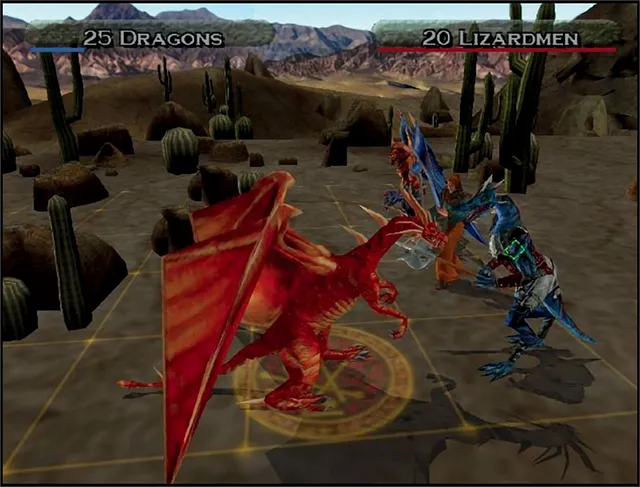
Above: The Dragonbone Staff combat is up close and personal, as had never been seen before in any previous version of a Heroes game, but the unit stacks still functioned identically to those found in the original King's Bounty.
上图:《龙骸灵杖之谜》的战斗表现是近景接战,这在以往《英雄无敌》的任何一个版本中都未曾出现过,但单位堆叠效果仍与原版《国王的赏金》中完全相同。
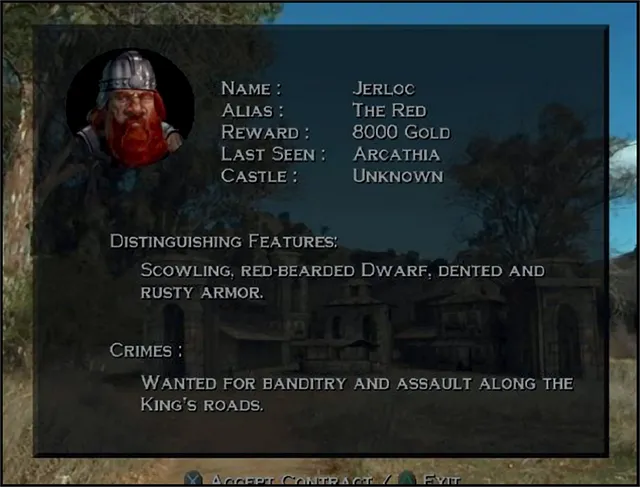
Above: The player was back to collecting bounties for renegade villains in Dragonbone and could gather useful intelligence on their targets. The villains' names, however, lacked the comic tone of the originals.
上图:玩家在《龙骸灵杖之谜》中又回到了追缉反派获得赏金的模式,并且能够获取有关这些目标的情报。不过,这些反派的名字已失去了原作那种诙谐的风格。