30周年回顾 第二章 追逐赏金
Chapter Two
"Chasing Bounty"

Given the names, it would be easy to assume that Heroes of Might & Magic is a direct descendant of the original Might & Magic franchise. The tremendous mountain of shared lore between the two franchises would also appear to support this supposition, but in truth, there's a significant ancestor in between from which Heroes actually descended. Released in 1990, King's Bounty established all of the core mechanics, gameplay, and graphical presentation that would be revived and rechristened in 1995. But the tale of development that leads from Might & Magic to King's Bounty to Heroes of Might & Magic is a winding one, and it begins most unexpectedly with New World's tortured attempt to make a Star Trek game.
从名字上看起来,人们很容易会认为《魔法门之英雄无敌》是原来《魔法门》系列的直接续作,这两个系列之间大量的共同故事情节似乎也支持了这一推测。但实际上,中间还存在着一个重要的先驱,《英雄无敌》系列正是从它之中衍生出来的。1990 年发行的《国王的赏金》已确立了所有核心机制、游戏玩法和图像呈现方式,这些在 1995 年又得以重现并换了个名字。但从《魔法门》到《国王的赏金》、再到《魔法门之英雄无敌》的发展历程曲折复杂,其最出人意料的开端竟然是 NWC 试图制作一款《星际迷航》游戏的失败尝试。
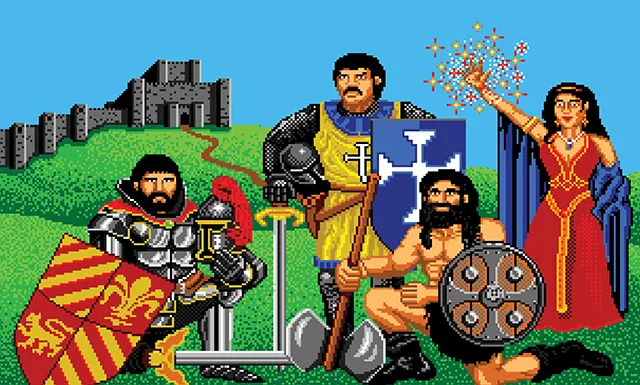
ABOVE: The character select screen from King's Bounty, featuring (from left to right) Sir Crimsaun the Knight, Lord Palmer the Paladin, Mad Mobam the Barbarian, and the Sorceress Tynnestra.
上图:《国王的赏金》中的角色选择画面,画面中从左至右依次为骑士克里姆桑爵士、圣骑士帕尔默领主、野蛮人疯穆罕以及女术士廷尼斯特拉。
During the early years of New World Computing, nearly every employee had two things in common. First, everyone had come to the company with years of tabletop or pen-and-paper gaming experience. Apart from any requisite computer skills, knowing how traditional games worked was essentially a job requirement. If you couldn't speak D&D, or Warhammer, or Axis & Allies, you weren't likely to get past an initial job interview. The second thing everyone had in common was that virtually everyone there self-identified either as a Trekkie or a Trekker (and understood the differences between the two, and had strong opinions about which was the appropriate moniker).
在 NWC 公司成立之初的那几年里,几乎每一位员工都有两个共同点。首先,所有员工都是从传统的桌游或纸笔游戏中走出来的,拥有多年的桌游经验。除了必备的计算机技能外,了解传统游戏的运作方式几乎是入职的必要条件。如果你不懂《龙与地下城》、《战锤》或者《轴心国与同盟国》等游戏,那么你不太可能顺利通过最初的入职面试。所有员工的第二个共同之处在于,几乎每个人都会自称是"星际旅行者"或者"星际探险者"(并且都清楚这两种称呼之间的区别,并且对哪种称呼更恰当有着明确的看法)。
For evidence of the company-wide devotion to Star Trek, one need look no further than the startup screen of any of their games. Their iconic logo, depicting a sword thrust through the Earth, is lifted directly from "Mirror, Mirror," an episode of the original Star Trek series. The early Might & Magic games all riffed on the idea of primitive societies who had no idea that they were living inside spaceships, a concept pulled directly from another original series episode, "For the World Is Hollow and I Have Touched the Sky." Throughout all of the New World era of Might & Magic games, there are numerous references to Star Trek, as well as to other iconic science fiction movies and television series.
要了解该公司全公司对《星际迷航》的热爱程度,只需看看他们任何一款游戏作品的启动画面即可。其标志性的图案"一把剑穿过地球"直接取自《星际迷航:原初》系列剧集中的《镜子,镜子》一集(第二季第四集,镜像宇宙的起源)。早期的《魔法门》系列游戏都借鉴了原始社会的设定,这些社会的人们根本不知道自己身处宇宙飞船之中,这一概念也直接源自《原初》系列另一集《因为世界是空洞的,我触摸了天空》。在 NWC 时代《魔法门》系列的所有游戏中,都有大量与《星际迷航》以及其他经典科幻电影和电视剧相关的致敬。

ABOVE: The Nero World Computing logo as it appeared in the 1992 computer game "Planet's Edge." The logo was lifted from the original Star Trek series episode "Mirror, Mirror," where it served as the symbol of the Terran Empire and was worn by the evil doppelgangers of Captain Kirk, Mr. Spock, and the rest of their alternate universe crewmembers aboard the ISS Enterprise.
上图:1992 年电脑游戏《星球边缘》中的 NWC 标志。该标志取自《星际迷航:原初》系列剧集中《镜子,镜子》中的内容,在该剧中它作为镜像宇宙人类帝国的徽章出现,登上企业号号国际空间站的镜像宇宙柯克船长、史波克先生以及其他成员都佩戴着。
For many at the company, the love of both Trek and tabletop strategy games was unified with Starfleet Battles, a deep combat game that featured Federation, Romulan, Klingon, and Gorn starships drawn from Star Trek's official canon, with new races and new ship classes added in for variety. The game was well-known for its complexity, ridiculous multi-volume rulesets, and hours-long fights between players as they argued over obscure rules. Virtually every major game convention of the era held Starfleet Battles tournaments, and three of its best players all worked for New World. Caneghem became the national Starfleet Battles champion in 1986, earning him the nickname of "Top Phaser" in the community. Consequently, on weeknights and weekends, it wasn't uncommon for the New World Computing conference room to break out into intergalactic war.
对于公司里的许多人来说,他们对《星际迷航》系列及桌面策略游戏的热爱与《星舰战争》这款深度战斗游戏完美融合在了一起。这款游戏包含了《星际迷航》官方正史中联邦、罗慕伦人、克林贡人和葛恩人的星舰,并新增了不同的种族和船型以增加多样性。这款游戏以其复杂性、荒诞的多卷规则集以及玩家之间因规则细节能展开数小时的激烈争论而闻名。当时几乎每一场重要的游戏展会都会举办《星舰战争》比赛,其中就有三位顶尖选手效力于 NWC 公司。坎内根于 1986 年成为《星舰战争》全国冠军,并在社区中获得了"顶级光炮"这一绰号。因此,在工作日的晚上和周末, NWC 公司的会议室里经常会爆发星际大战。
Given the love they had for both Star Trek and gaming, it was no great leap for them to decide that they wanted to make a Star Trek game, but first they needed to obtain a license. An initial call to Paramount would prove frustrating, and Caneghem would be told that the traditional publishing house Simon & Schuster held all of the appropriate rights. A computer gaming deal simply couldn't be had, or at least not in the current circumstances. Despite this, Caneghem and Caldwell reasoned that the publishers of Starfleet Battles—Task Force Games— clearly possessed some kind of gaming agreement, so perhaps a deal could be made through them.
鉴于他们对《星际迷航》及游戏的热爱,他们自然而然地决定要制作一款《星际迷航》的游戏,但首先他们需要获得相关授权。他们首次致电派拉蒙公司,结果却令人沮丧,坎内根得知所有相关的版权在传统出版社西蒙与舒斯特公司手中,要达成制作电脑游戏的协议是不可能的,或者至少当前不可能。尽管如此,坎内根和考德威尔认为,《星舰战争》的发行商"特遣队游戏公司"显然拥有某种游戏制作协议,所以或许可以通过他们达成交易。
"It turned out that Paramount had made a lot of mistakes with Star Trek," recalled Caldwell. "Lots of things were being used without licensing fees going back and forth. The NCC1701 designation of the Enterprise was in the public domain because they'd forgotten to copyright it. Task Force Games had worked out that they could do all kinds of things except make a movie, but they could make games." So, we thought, "Hey, why don't we license the rights to make a Starfleet Battles game instead of a Star Trek game, and we could get all the same stuff?"
"结果发现派拉蒙在《星际迷航》方面犯了很多错误。"考德威尔回忆道,"在使用的很多内容都是未经许可且未支付版权费用的。企业号星舰 'NCC1701' 处于公共领域,因为他们忘了对其进行版权保护。特遣队游戏公司发现他们除了拍摄相关电影什么都可以做,包括开发游戏。"于是我们想:"嘿,为什么我们不直接获取《星舰战争》的游戏版权,获得同等于制作《星际迷航》游戏的授权呢?"
After meeting with Task Force Games and talking over the details, Caneghem and Caldwell came to the startling conclusion that it would be cheaper and easier to buy the publisher, Taskforce Games, outright than to license Starfleet Battles. "We threw the checkbook down, and we bought the whole company. I flew out to Amarillo, Texas, wrapped up the entire company into a boxcar train and shipped it back to California."
在与特遣队游戏公司会面并详细讨论后,坎内根和考德威尔得出了一个令人震惊的结论:直接收购游戏发行商特遣队游戏公司要比获得《星舰战争》版权更便宜、更便捷。"我们掏出了支票簿,然后就买下了整个公司。我飞到得克萨斯州的阿马里洛,把整个公司装进一列货车里运回了加利福尼亚。"
Believing that the way was now clear for them to start making the Star Trek game of their dreams, New World began planning their next move, but a strongly worded letter from Paramount stopped the game in its tracks. They were reminded, once again, that the necessary rights belonged to Simon & Schuster, and that the Task Force Games acquisition hadn't brought them any closer to their goal.
NWC 公司本来认为现在万事俱备,可以着手开发他们梦寐以求的《星际迷航》游戏了,于是开始规划下一步行动。但派拉蒙公司一封措辞严厉的信件却让游戏的开发工作戛然而止。他们再次被提醒,所需的版权属于西蒙与舒斯特公司,而且收购特遣队游戏公司并不能帮助他们接近自己的目标。
Without the funds to fight what was sure to be an expensive legal battle, Caneghem decided to table their Star Trek plans for the time being and focus on a game over which they would have complete creative control. "I'd always wanted to make a strategy game that was fantasy themed." Although he'd clearly established his role-playing bona fides with Might & Magic I and Might Magic II, he was eager to build something different than he'd done before. "The thing with RPGs is that you played through this long and evolving story, and then you reached the end and then you were done. What I wanted to do instead was create a kind of fantasy chess game. You'd have these creatures on a battle board, and you'd fight against another player with stacks of creatures, and you could play over and over again. And you could adjust the difficulty so that you could play a game in an hour, or play for two days, or choose something really difficult or really easy. Replayability was my number-one goal, and that grew out of my love of board games—how their system could seem so simple, but they're obviously so deep."
由于没有资金来应对这场肯定会耗费巨资的法律纠纷,坎内根决定暂时搁置他们的《星际迷航》计划,转而专注于一款他们能够完全掌控创意的游戏。"我一直都想制作一款以奇幻为主题的战略游戏。"尽管他凭借《魔法门1》和《魔法门2》已经确立了自己在角色扮演游戏领域的地位,但他渴望创作出不同于以往的作品。"角色扮演游戏的特点是,你会经历一段漫长且不断发展的故事,等到故事结束,游戏也就结束了。而我想要做的是打造一种奇幻版的国际象棋游戏。你会看到那些生物在一张棋盘上,并与另一位玩家进行对战,对方也会派出一连串的生物进行攻。你们可以反复进行游戏。而且你可以调整游戏的难度,然后可以在一小时内完成一局游戏,或者也可以连续玩两天,再或者选择难度极大或极小的模式。可重复性是我的首要目标,这源于我对桌游的喜爱——尽管它们的玩法看似简单,但实际上却蕴藏着很深的内涵。"
Caneghem and company dove deep in their analysis of other established games while they searched for inspiration. The team's lead artist, Vincent De Quattro, recalled, "When the team was designing, we'd been big fans of a traditional board game called Troll, where you'd progress along a hex-based board marshaling your deck and basing your strategies on the relative strengths and weaknesses of the characters and classes you'd acquire along the way. I remember Jon saying it would be cool to combine our previous RPG game engine with a lighter style of play, requiring less time to win the game and offering unlimited random replays."
坎内根及其团队在深入分析其他成熟游戏的同时,也在努力寻找创作灵感。团队的首席美术文斯·德·夸特罗回忆道:"在设计过程中,我们团队一直非常喜欢一款名为《巨魔》的传统棋盘游戏(实际为一款现代战争策略游戏,巨魔指一种巨型坦克)。在游戏中,你需要沿着一个基于六边形的棋盘移动,集结你的牌组,并根据一路上获得的角色和职业的相对强弱来制定策略。我记得乔曾说,将我们之前的角色扮演游戏引擎与更轻松的游戏风格相结合会很酷,并能缩短游戏获胜所需的时间,提供无限次的随机重玩机会。"
Another game called Titan was particularly intriguing and inspired one of King's Bounty's core features. "There were things in Titan that we'd liked, like the ability to have a stack of creatures," Caldwell explains. "You'd buy your stack and open them up like a deck of cards. But it's a hexagon board, and you'd pick up your stack of creatures, and what you knew was, there's this massive stack of creatures coming your way, and you could attack this stack of creatures, but you didn't know what was really in it until you attacked it. So, it was sort of a mystery. And you'd unfold these things, and you'd fight among your monsters, and you'd kill some. The winning guy got to move on."
另一款名为《泰坦》的游戏尤其引人入胜,并启发出了《国王的赏赐》的核心特点之一。"在《泰坦》游戏中有一些我们喜欢的元素,比如可以将生物堆叠起来。"考德威尔解释道,"你可以购买这叠生物,然后像打开一副扑克牌那样打开它们。不过它们是六边形的棋子,而你可以放置你的生物堆叠。你也知道会有许多生物堆叠朝你袭来,你可以攻击某个生物堆叠,但直到你对其发动攻击之后,你才会明白具体数量是多少。所以,这还有点神秘。你会逐步解开这些谜团,然后带你的怪物们展开战斗,杀死一些敌人。最终的获胜者才能继续前进。"
Caneghem particularly liked the nature of Titan's monster stacks but put his own spin on them for King's Bounty. "I think the biggest innovation was that you'd have this stack of creatures. So, the little icon onscreen wasn't just a Skeleton or a Dragon. It was five Skeletons, or twenty-three Dragons or whatnot, and that allowed for more strategies and tactics. With single units on the map, you'd have your fighter and your cleric, and they had hit points and whatever, but the stacks were like consumables. It became a game of attrition as opposed to a series of one-off battles. And the math was surprising, because when you visually looked at it, you didn't know who would win when two stacks came at each other. Sometimes it would be close, or sometimes it would be, Oh, well, I barely lost one Dragon, and I killed one hundred of these guys, or vice versa. And depending on the stats, and then the modifiers and the items, it got really deep, really quickly. That one mechanic was the pivotal piece."
坎内根尤其喜欢《泰坦》怪物堆叠的设定,但在《国王的赏赐》中对这一设定进行了自己的改编。"我认为最大的创新在于,你会看到这样一个怪物堆叠的数量。屏幕上的小图标不再只是骷髅或龙,而是五只骷髅、二十三条龙或者诸如此类,这为更多的策略和战术提供了可能。在地图上只有单个单位的情况下,你会有战士和牧师,他们都有生命值之类的属性。但这些堆叠就像是消耗品,这变成了一种消耗战的游戏,而不是连续的一次性战斗。而且计算结果更令人惊讶,因为当你从视觉上观察时,并不知道当两个堆叠相互攻击时谁会获胜。有时会很接近,有时则会是"哦,好吧,我只损失了一条龙,就消灭了一百多只这种家伙",或者反之亦然。而且根据属性、加成和物品的不同,它很快就变得非常复杂,非常深入。这一机制是关键所在。"
深远的影响 - Long Legacy
While many aspects of the original King's Bounty were either altered or dropped for the later Heroes of Might & Magic computer game, Caneghem's "monster stacks" battling it out on a combat grid remains the core gameplay mechanic around which the game is built. Over the years, this same concept has been lifted—almost without alteration—into other strategy games made by other companies.
虽然在后来的《魔法门之英雄无敌》电脑游戏中,原《国王的赏金》中的许多内容要么被修改、要么被删除,但坎内根设计的"怪物堆叠"在战斗网格上进行激烈对抗,仍然是这款游戏的核心游戏机制,围绕着这一机制构建了整个游戏框架。多年来,这一理念几乎未作改动,就被移植到了其他由其他公司制作的策略游戏中。
The objective of King's Bounty was for the player to recapture a stolen artifact known as the Sceptre of Order which was hidden somewhere on the world map. As each villain was captured and reclaimed for bounty, a new portion of the map would be uncovered for the player, providing clues to where the Sceptre was buried.
《国王的赏赐》游戏的目标是让玩家找回一件名为"秩序权杖"的被盗物品,该物品藏在世界地图的某个地方。每当一个反派被抓获并换得赏金时,游戏地图就会再揭开一部分,为玩家提供线索,帮助他们找到权杖的埋藏地点。
Although the gameplay in King's Bounty was focused on combat, the underlying economic objectives of the game proved to be a challenge to design. "The balance was a big, big trouble for me. I had this upkeep requirement, so say you recruited a hundred dragons. Will they cost you a zillion dollars a day to feed? You'd be cash negative if you just wandered around with them. You'd have to use them to win a battle in order to keep your budget positive. That was fun to balance, but I think it was the most difficult thing, to figure out how to make those numbers work. It kept you on your toes so you couldn't just go berserk. I got rid of that feature when we went to Heroes of Might & Magic though, because it didn't appeal to a wider audience. It was for geekier people like myself."
尽管《国王的赏金》的游戏玩法侧重于战斗,但游戏背后的经济目标却给设计带来了巨大的挑战。"平衡问题对我来说是个大难题。我提出这个维持成本的要求,比如说你招募了一百条龙。它们每天的饲养费用会不会高达数百万美元呢?如果你只是随意带着它们到处走,那你就会出现现金负数的情况。要想保持预算收支平衡,你就得利用它们来赢得一场场战斗才行。平衡这些数字的过程挺有趣的,但我觉得这也是最难的部分,也就是得想办法让那些数字合理起来,能让你时刻保持警觉,又不会令你发狂。不过在我们开发《魔法门之英雄无敌》系列游戏时,就取消了这个功能,因为它无法吸引更广泛的玩家群体。只适合像我这样比较硬核的人。
Benjamin Bent was yet another member of the New World Computing team initially recruited to help with the testing of Might & Magic II. A longtime friend of Mark Caldwell and fellow Air Force veteran, Bent had joined the company in 1989. As a tester, he'd already become a bit jaded from seeing all the rough edges of a project during early development. Nonetheless, he felt good about how King's Bounty was progressing. "It was easy to tell it was going to be a fun game. I wasn't sure if it was expansive enough at first though. Might Magic was a big game, and it took many, many hours to play it. I thought Bounty was small, like playing Uno, something that's fun, but you're doing the same thing over and over all the time. But by the time King's Bounty ended up being finished, it was much bigger than I ever anticipated."
本杰明·本特是 NWC 公司团队的又一成员,最初被招募来协助测试《魔法门2》。他是马克·考德威尔的老朋友,也是空军退伍军人,于 1989 年加入了该公司。作为一名测试员,他已经对项目早期开发过程中出现的各种问题有些厌倦了。不过,他对《国王的赏金》的进展还是感到满意。"很容易就能看出这会是一款有趣的游戏。但起初我并不确定它是否足够丰富。《魔法门》是一款大型游戏,要玩完它得花很多很多个小时。而我本来认为《国王的赏金》体量很小,就像打 UNO 牌一样,是那种有趣且可以一直重复的游戏。但等到《国王的赏金》最终完成时,它的容量比我预想的要大得多。"
As Caneghem led the design, Caldwell took the lead on the programming front. He'd assisted with the coding of Might & Magic II and the various ports to other platforms, but King's Bounty would be the first game on which he was the principal programmer. His technical wizardry, along with that of Caneghem and fellow programmer Stephen Cox, is credited by De Quattro with elegantly solving the major art production hurdles. "By the time I was given the work for King's Bounty, we'd already collaborated on several projects. The programming team was able to create a specialized set of image animation libraries that utilized unique and optimized ways to present story points, puzzles, and revelations. We would come up with an effect, like an animated candle flame for example, that was quite difficult in the early days of limited main memory and almost zero video memory to craft into a game experience. I remember wanting to push these 'immersive' effects and would design things like flares or sparkles or depth hazing, and then I'd pitch them in development meetings, and depending on which programmer loved the idea, somehow the team would accommodate these details into the overall game despite time constraints and code limitations."
在坎内根负责设计工作的同时,由考德威尔来负责程序方面的设计。他曾参与过《魔法门2》以及各种移植到其他平台游戏的编程工作,但《国王的赏金》是他担任主要程序员的第一款游戏。德·夸特罗认为,考德威尔、坎内根以及助理程序员斯蒂芬·考克斯的高超技术共同出色地解决了大型艺术创作过程中的重大难题:"当我接到《国王的赏金》的工作时,我们已经合作过好几个项目了。编程团队成功开发出了一套专门的图像动画库,采用独特且优化的方式呈现故事要点、谜题和揭示内容。当我们想出一种效果,比如一个烛焰动画,这在早期主内存有限、显存几乎为零的情况下,要将其转化为游戏体验是非常困难的。我记得当时很想强化这些‘沉浸式’效果,于是会设计诸如火焰、火花或是深度模糊这类元素,然后我会在开发会议上提出这些想法,看哪位程序员会喜欢这个创意,这样一来,即便受到时间限制和代码限制的约束,团队也会想办法将这些细节融入到整个游戏中去。"
Per Caneghem's original vision for the project as a form of fantasy chess, there was very little in the way of storytelling within the game, giving writer Beliaeff very little to do apart from helping to name characters, locations, and items. "King's Bounty didn't have any of the science-fiction elements or the ultimate twist that Might & Magic had. It was pure fantasy." At the start of the game, the player was able to choose from one of four different hero characters (though they weren't yet called heroes) who represented one of the playable classes—Barbarian, Knight, Paladin, or Sorceress. Each would have a different set of stats that influenced their magical abilities, the power of their troops, their leadership, and the amount of income they could draw during each game week. In contrast to Heroes of Might Magic, however, each of these heroes was essentially a blank slate with no back histories or personalities, and they'd simply regenerate and return to the battlefield whenever they were defeated. By contrast, the villains all got interesting dossiers. "If you look at the villains in King's Bounty, they were all plays on the names of people that worked there or people that hung out there, or our friends, so Arech Dragonbreath is named for Eric Hyman! Lots of silly tropes like that." These nods to New World employees would become a regular feature of future games, and even as the tradition of including jokes and goofy names would eventually wane in Heroes of Might & Magic, in-game portraits for player characters and Heroes would notably preserve the faces of former New World employees long after they'd left the company (including several variations on the mug of this book's author).
根据坎内根最初为该项目设定的奇幻棋类游戏的构想,游戏中几乎没有故事元素,这使得编剧贝利亚夫除了帮忙给角色、地点和物品命名之外,几乎没有什么可做的工作。"《国王的赏金》没有科幻元素,也没有《魔法门》那样的终极转折。它纯粹是奇幻。"在游戏开始时,玩家可以从四位不同的英雄角色(尽管当时他们还未被称为英雄)中进行选择,分别代表了四种可选择的职业——野蛮人、骑士、圣骑士或女术士。每位英雄都会有不同的属性组合,这些属性会影响他们的魔法能力、部队的威力、领导力以及每个游戏周期所能获得的收入。与《英雄无敌》系列不同的是,这些英雄基本上都是空白模板,没有过往经历或个性,只要被击败就会自动复活并重返战场。相比之下,反派角色倒是都有有趣的人物档案。"如果你看看《国王的赏金》中的反派角色,他们都是以那里工作人员的名字、在那里活动的人物的名字,或者是我们朋友的名字来命名的,比如阿雷奇·龙息就是以埃里克·海曼(《核战狂人梦》的设计师之一)的名字命名的!还有很多类似的荒诞情节。"这些对 NWC 员工的致敬将成为未来他们游戏的一个常见特色,尽管《英雄无敌》系列中包含笑话和古怪名字的传统最终逐渐式微,但游戏中为玩家角色和英雄设定的肖像仍会显著地保留前 NWC 员工的面容,即便他们在公司离职很久之后也是如此(包括本书作者这张脸的不同变体)。
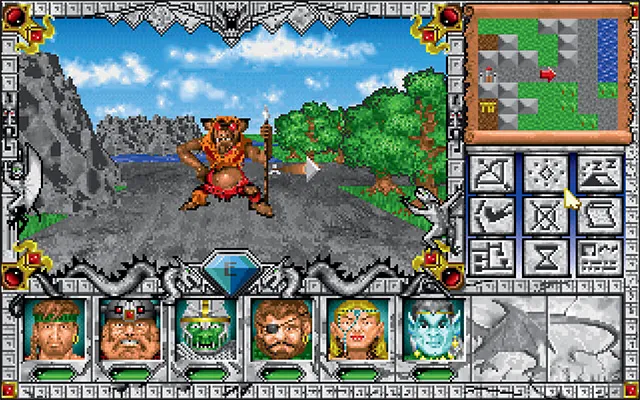
ABOVE: Gag portraits of New World Computing employees continued a long tradition of gag names and insider jokes that had begun with Might & Magic II under writer Nicholas Beliaeff. At far left is a riff on New World Computing founder Jon Van Caneghem. Your author is found three more portraits over, looking quite piratical. Taken from Might & Magic III: Isles of Terra.
上图: NWC 公司员工的恶搞肖像延续了长期以来恶搞名字和内部笑话的传统,这一传统始于编剧尼古拉斯·贝利亚夫在《魔法门2》中所开创的先河。最左边的正是 NWC 公司创始人乔·万·坎内根的恶搞肖像。本书作者则与他隔着两幅肖像,看起来颇具海盗风格。这张图取自《魔法门3:幻岛历险记》。
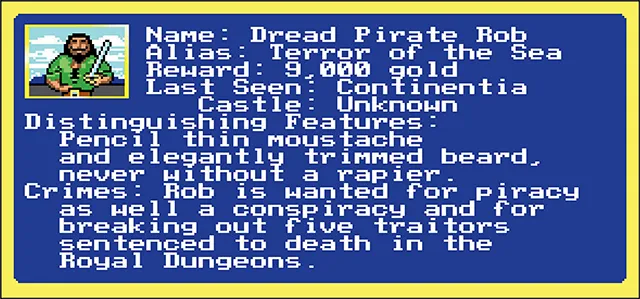
ABOVE: The Dread Pirate Rob, a.k.a. Terror of the Sea, was one of the many villains in King's Bounty who was blessed with a backstory from loremaster Beliaeff. The name was a none-too-subtle nod to the hero of the 1987 movie The Princess Bride, played by Cary Elwes.
上图:"恐怖海盗罗布",又名"海洋之恐怖",是《国王的赏金》中众多反派角色之一,其背景故事是由传闻大师贝利亚夫所创作的。其名字暗含了对 1987 年电影《公主新娘》中由卡里·埃尔韦斯饰演的主人公的致敬。
King's Bounty would at last be released in 1990. Despite critical acclaim and the garnering of several five-star reviews, it was a financial disappointment to Caneghem. "It didn't do a lot of big numbers. It was enough to make a profit, but it wasn't a big hit like the Might & Magic series was, just in terms of selling tons of units at the time." Though he had resigned himself to stick to the creation of role-playing games, he found his most passionate defender of King's Bounty in his second wife Deborah, who counted the game as being one of her favorites. "She was the one who kept the dream alive," Caneghem said. "She couldn't get enough of it. No one was happier when we decided to try again with Heroes."
《国王的赏金》最终于 1990 年发行。尽管获得了广泛的好评以及获得了多项五星评价,但坎内根在财务方面却感到非常失望。"它没有取得太大的销量成绩。能盈利就已经足够了。不像《魔法门》系列那样成为大热门,当时它只是销量不算太高的游戏而已。"尽管他已决定继续专注于角色扮演游戏的创作,但他发现《国王的赏金》最坚定的支持者是他的第二任妻子黛博拉,她将这款游戏视为自己最喜欢的游戏之一。"是她让这个梦想得以延续,"坎内根说,"她对这款游戏爱不释手。当我们决定用《英雄无敌》来再次尝试时,她是最高兴的。"
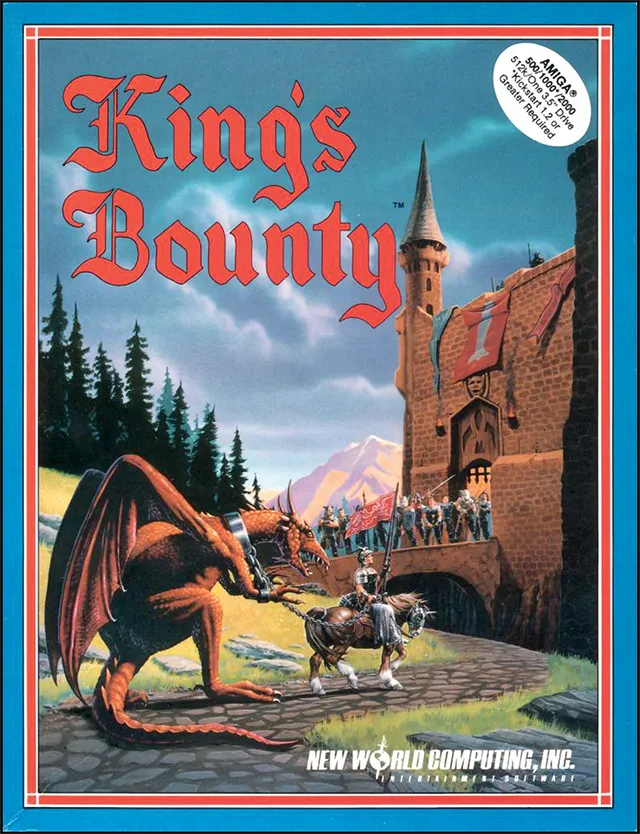
ABOVE: The cover of King's Bounty, released by New World Computing in 1990.
上图:由 NWC 公司于 1990 年出版的《国王的赏金》封面。